Look a little closer
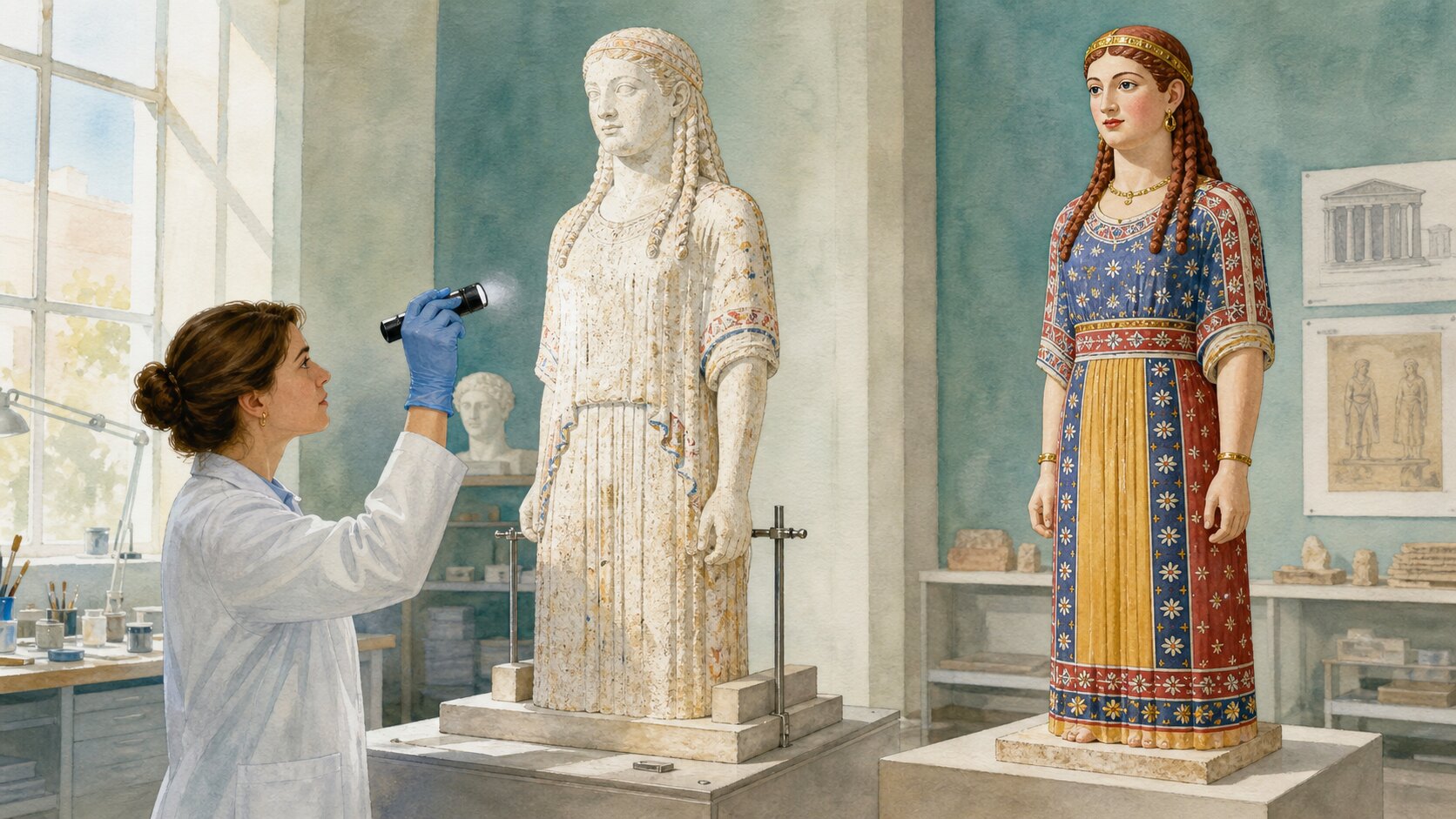
Most ancient Greek and Roman marble statues look white in museums today, but many were originally painted and sometimes gilded or fitted with other colored materials. Some sculptures carried extensive color across flesh and clothing; others used paint selectively for eyes, lips, hair, patterns, or attributes. Weathering, burial, and cleaning removed much of the fragile surface decoration, leaving marble that later viewers mistook for the intended finished appearance.
The use of multiple colors on sculpture is called polychromy. For an ancient maker, marble could provide both carved volume and a ground for color. Pigment distinguished skin from textile, defined jewelry and armor, supplied pupils and hair, and made patterns legible from a distance. Gold leaf, metal attachments, glass, and stone inlays could add further contrasts. Treating sculpture and painting as completely separate arts therefore imposes a modern division on many ancient objects.
The most direct evidence survives on the objects themselves. Protected recesses between locks of hair, beneath arms, and inside folds may retain particles of red, blue, yellow, or black visible even without instruments. Microscopy detects smaller grains and sequences of layers. Raking light can reveal incised designs or 'paint ghosts,' where a former coating protected one patch of marble from weathering differently from its surroundings. A statue that seems uniformly white across a gallery can still preserve a patterned surface record.
Conservators also use imaging and spectroscopy to find traces invisible in ordinary light. Ultraviolet fluorescence and reflected-ultraviolet photography accent differences in surface materials. Visible-induced luminescence can map the infrared emission characteristic of Egyptian blue. X-ray fluorescence detects elements associated with pigments, while Raman spectroscopy and microscopic sampling can identify mineral structures more specifically. A reconstruction becomes more persuasive when several methods converge on the same material and location rather than when it rests on one bright analytical spot.
Ancient palettes varied with date and place but could include red and yellow ochres, carbon black, copper-based blues and greens, vermilion, and gilding. Pigments might be applied with organic binders, wax, or preparatory layers rather than simply rubbed onto bare stone. The Acropolis Museum has investigated evidence and experimental possibilities for encaustic work using heated colored wax on some sculptures. A technique identified on one object, however, cannot be projected onto every Greek and Roman statue across many centuries.
Color disappeared because its layers were far more vulnerable than the stone beneath. Outdoors, light, rain, salts, and thermal cycles weakened binders and loosened pigment. Burial introduced moisture and soil chemistry. Excavated surfaces could deteriorate rapidly after exposure to air, and earlier restorers sometimes scrubbed or scraped marble in pursuit of a clean white appearance. The durable carved body and delicate painted skin traveled through time at very different rates.
Famous sculptures recovered during and after the Renaissance were often already pale, helping establish the Western ideal of a white classical past. Artists and theorists associated uncolored marble with restraint and ideal form, and Neoclassical architecture and sculpture reinforced that taste. Traces of paint were noticed, but they could be dismissed as later additions or minor decoration. Modern conservation science does not make the current white surface unreal; it distinguishes that historically altered state from the object's ancient completion.
Colored replicas in exhibitions are not infallible time machines. Analysis may reveal a pigment and part of a pattern while leaving lost glazes, intermediate tones, sheen, binding media, and subtle treatment of flesh uncertain. Researchers combine surviving grains, tool and surface marks, ancient texts, and contemporary images to propose one evidence-based possibility, then revise it when findings change. A reconstruction that looks vivid to modern eyes neither proves crude ancient painting nor guarantees that every hue is exact.
A white marble statue is an authentic survivor shaped by age, excavation, collecting, and conservation, but it is not necessarily a complete picture of the original work. Ignoring color removes the gaze, textile design, distinctions of skin and material, and flashes of metal that once worked with carved form. Following microscopic pigment and optical evidence restores ancient sculpture as a composite art of stone, color, attachments, and controlled shine rather than a world designed only in white.
EDITORIAL RESPONSIBILITY
FactosBrain Editorial Desk
The FactosBrain Editorial Desk researched and reviewed this article under our editorial policy. We assess error reports under our corrections policy.