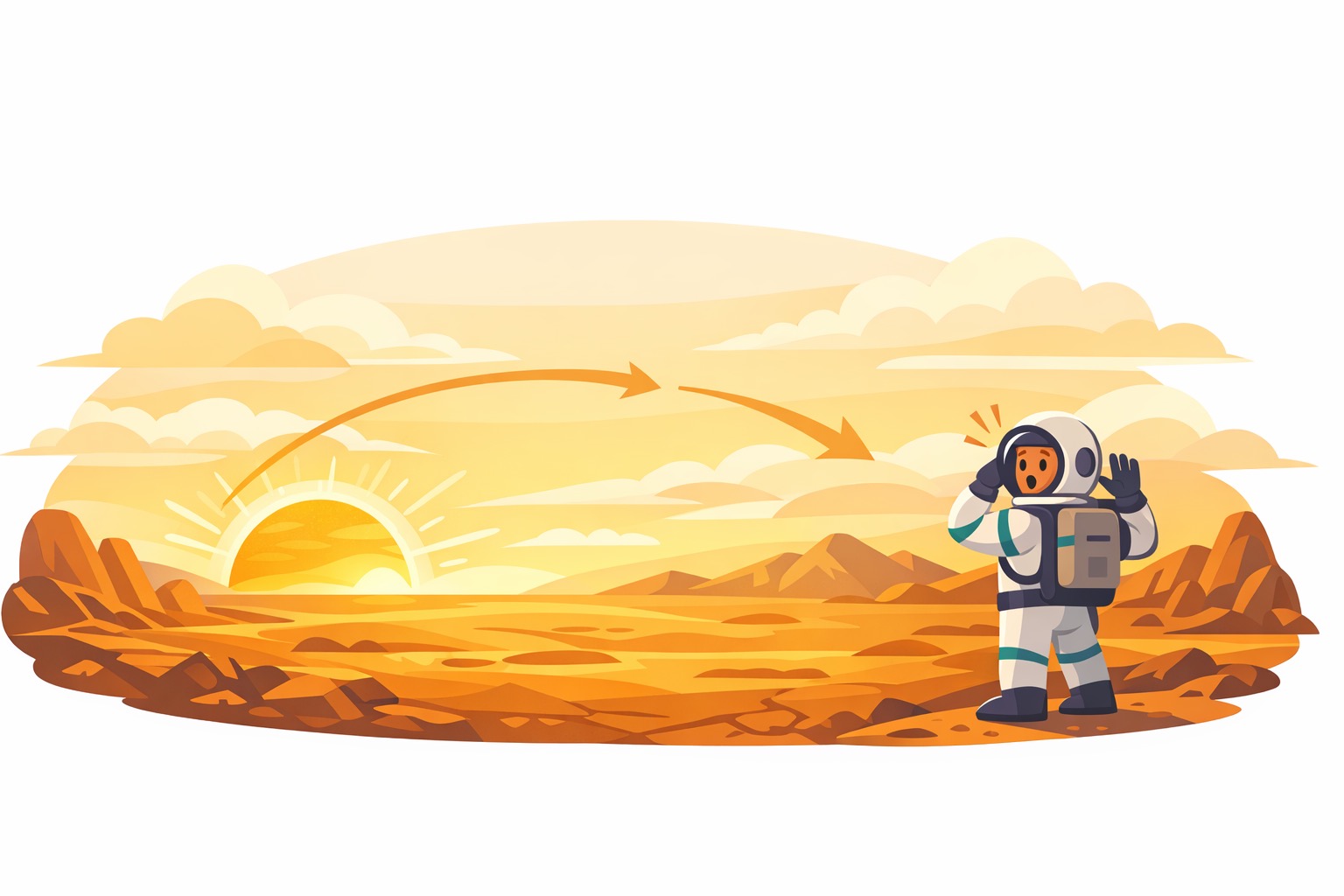
From the surface of Venus, the Sun would move across the sky in the opposite direction from the one familiar on Earth: it would rise in the west and set in the east. The reason is not a reversed orbit. Venus travels around the Sun in the same general direction as most planets, but it rotates on its axis in the opposite direction.
Astronomers call this retrograde rotation. Viewed from above the solar system's north side, Earth rotates counterclockwise, while Venus turns clockwise. The rotation is also extraordinarily slow: one turn relative to the distant stars takes about 243 Earth days, longer than Venus needs to complete its roughly 225-day orbit.
A sunrise-to-sunrise day is not the same as that 243-day rotation period because Venus is moving around the Sun while it turns. The combination produces a solar day of about 117 Earth days. A visitor able to see through the clouds would therefore watch the Sun crawl west-to-east with extreme slowness.
In practice, the view would be nothing like a clear terrestrial sunrise. Venus is wrapped in a deep atmosphere dominated by carbon dioxide and covered by clouds containing sulfuric acid droplets. The surface receives a dim, diffuse glow, and the crushing pressure and temperature make direct observation by a person impossible.
Scientists still debate exactly why Venus ended up rotating this way. Gravitational tides raised by the Sun, atmospheric tides and large impacts early in the planet's history may all have influenced its spin. The present direction is well measured, but a single, fully confirmed origin story has not been established.
Saying that the Sun rises in the west is thus a statement about apparent motion from the ground. The Sun itself has not changed direction, and Venus has not reversed its path around it. A planet's sky is shaped by two motions at once—its orbit and its spin—and Venus combines them in one of the solar system's strangest daily rhythms.
EDITORIAL RESPONSIBILITY
FactosBrain Editorial Desk
The FactosBrain Editorial Desk researched and reviewed this article under our editorial policy. We assess error reports under our corrections policy.