Look a little closer
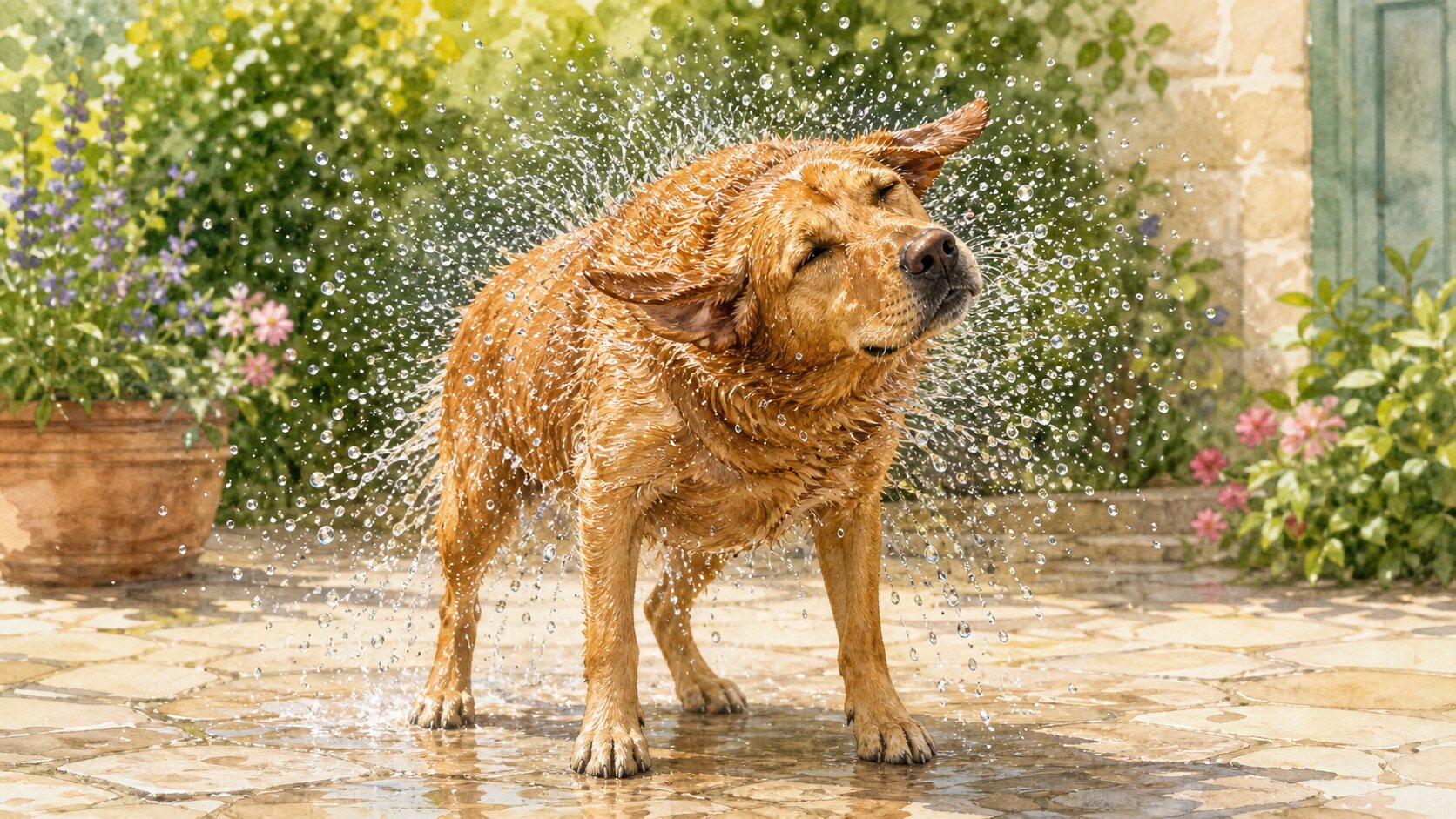
A wet dog dries rapidly by twisting its head and trunk back and forth around the spinal axis until droplets can no longer follow the accelerating fur. Surface tension holds water to hairs, but loose skin and fur whip through a larger, faster motion than the skeleton beneath. When the inward force required to keep a drop moving with the hair exceeds what its contact can supply, the drop detaches and continues outward.
Gravity alone does not immediately drain a soaked coat. Surface tension and wetting pin drops to fine hair bundles, while capillary spaces retain water among fibers. A drop traveling with a curved hair path requires inward centripetal acceleration, which grows with the radius of motion and with the square of angular speed. Rapid oscillation raises that demand sharply. Once inertia wins over the capillary attachment, the drop leaves roughly along a tangent and breaks into the familiar spray.
The dog does not spin continuously like a top. With its feet planted, it reverses the rotation of its head and torso in a motion that high-speed recordings approximate as harmonic oscillation. Markers on the back show that skin and fur sweep through much larger angles than the vertebral column. Loose dermal tissue lags and whips around the body, increasing the effective radius and peak speed at the hair tips. It is a mechanical amplifier that extracts more droplet acceleration from the animal's muscular twist.
A 2012 study in the Journal of the Royal Society Interface filmed 33 wet mammals representing 16 species and five dog breeds at 500 to 1,000 frames per second. Labrador shakes used for detailed kinematics averaged about 4.5 cycles per second; dogs in the broader sample were around 4.5 to 8 hertz. Mice reached roughly 30 hertz, whereas bears were near 4 hertz. Frequency declined systematically with body mass, although anatomy and behavior mean these figures are observed ranges, not a metronome setting for every individual.
Size explains the direction of that trend. At the same angular speed, a small body's shorter radius produces less centripetal acceleration, so a small mammal must cycle faster to reach the threshold for drop release. A model balancing water's capillary attachment against inertia predicted frequency to scale approximately with body mass to the power of −0.19. The measured exponent was about −0.22 across animals spanning four orders of magnitude in mass. The close values support a size-tuned mechanism rather than arbitrary trembling.
Faster is not endlessly better. In experiments with animal fur on a mechanical shaker, frequencies comparable to those observed removed about 70 percent of the accumulated water, while additional speed produced diminishing returns. The smallest residual drops are harder to eject because surface effects are large relative to their mass. Muscles must also power each reversal. The useful compromise is therefore to expel most large drops within seconds, not spend disproportionate energy pursuing a perfectly dry coat.
The saving matters thermally as well as mechanically. Waterlogged fur replaces insulating air and conducts heat away more readily, while evaporating the retained water requires substantial latent heat. The 2012 paper illustrated the scale with a calculation: a roughly 60-pound dog carrying one pound of water could spend energy equivalent to about 20 percent of its daily caloric intake if evaporation alone supplied the drying. This was a model estimate under stated assumptions, not a direct metabolic measurement for every dog, but it shows why mechanical removal is valuable.
Starting the shake is a sensory question separate from throwing the drops. A 2024 mouse study found that water or oil drops on hairy back skin recruited Piezo2-dependent C-fiber low-threshold mechanoreceptors and a spinoparabrachial pathway that promotes wet-dog shakes. The result supports the idea that movement of hairs and skin by droplets triggers a defensive motor program. The detailed circuit was established in mice, however, and should not be presented as a complete neural map already demonstrated in domestic dogs.
Efficiency also depends on the liquid and coat. Oils with different viscosity, surface tension, and wetting behavior may not fragment or release like water; hair length, density, body region, skin looseness, and breed can alter the spray. Humans lack both a dense fur layer and the same large loose-skin whip, so imitating the twist provides little benefit. The wet-dog shake is a linked system: touch initiates rapid torsion, loose skin amplifies hair-tip motion, body size sets a useful frequency, and the resulting acceleration overwhelms the capillary grip of most water drops.
EDITORIAL RESPONSIBILITY
FactosBrain Editorial Desk
The FactosBrain Editorial Desk researched and reviewed this article under our editorial policy. We assess error reports under our corrections policy.