Look a little closer
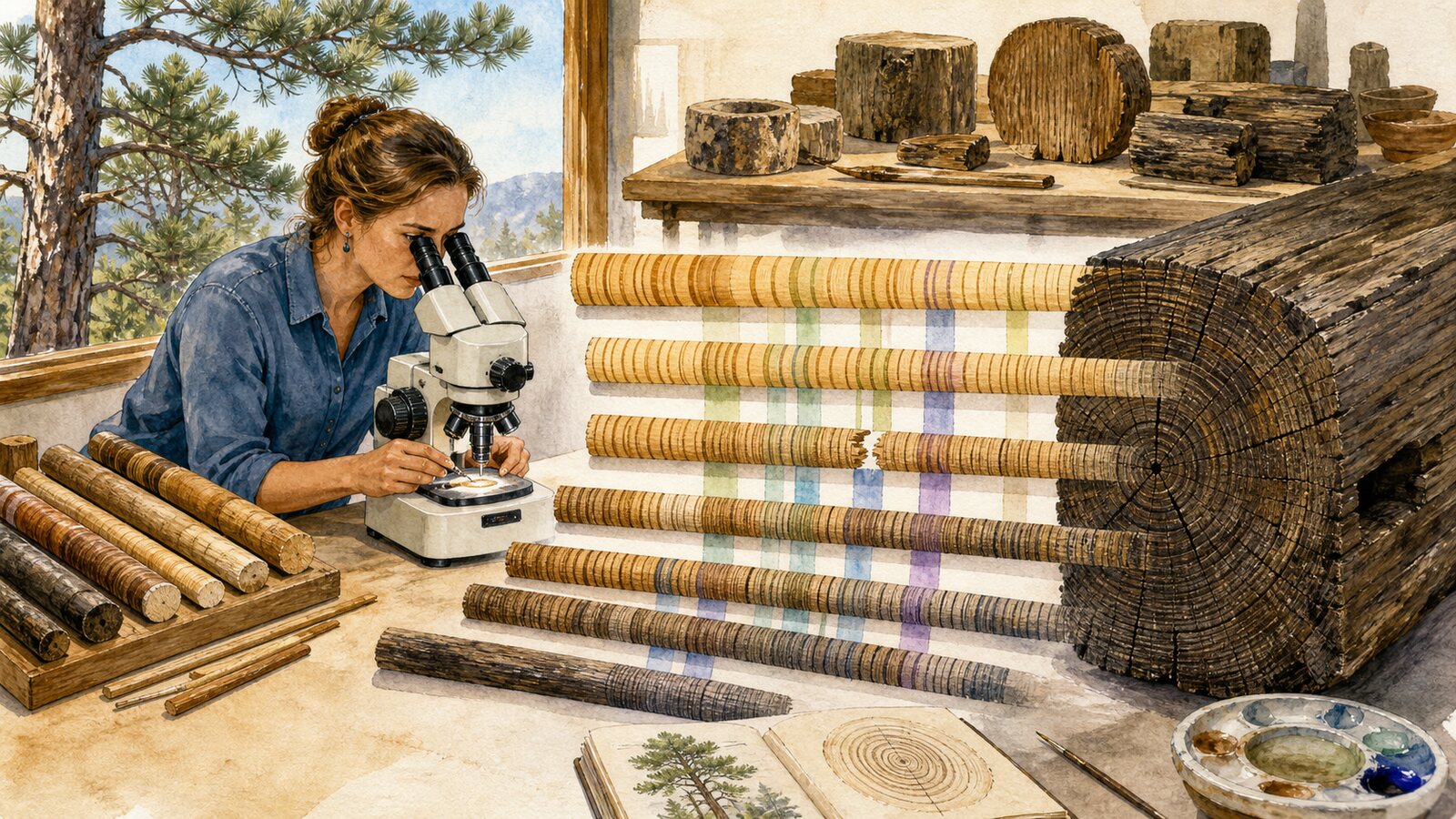
Dendrochronologists date old timber by matching a long sequence of wide and narrow rings against a reference chronology whose calendar years are already known, not by merely counting circles. This process, called crossdating, exposes missing and false rings and assigns each surviving ring to its year of growth. If the outer wood is complete, the method can sometimes identify the year a tree was felled.
Many trees in seasonal climates form recognizable annual boundaries. Relatively large, thin-walled cells produced early in the growing season make paler earlywood; smaller, thicker-walled cells later in the season create darker latewood. Together they normally constitute one year's growth before the next earlywood begins. Counting the light and dark portions as separate years would double the apparent age before any historical comparison even started.
Ring width is both a time increment and a response to conditions. Trees of the same species in a region may all grow narrowly during a limiting drought or cold season and more broadly in a favorable year. Age, soil, competition, injury, and disease add individual variation, so no two records are carbon copies. What can persist across specimens is a distinctive rhythm of relative narrowness and width caused by shared environmental constraints.
Researchers extract pencil-thin increment cores from living trees or structural beams, or record an exposed cross-section. In the laboratory they prepare the surface, identify boundaries under magnification, and measure widths precisely. Statistical treatment removes broad age-related growth trends and tests whether a proposed alignment is stronger than chance. Software can flag a candidate match, but specialists still inspect wood anatomy, damage, and anomalous rings before accepting it.
A master chronology is not built by finding one tree that lived through the whole historical period. Investigators begin with living trees anchored to the present, then match their older rings with the younger portions of dead wood. Still older logs and building timbers overlap the growing sequence in turn. This chain of shared intervals can extend a regional calendar backward for centuries or millennia and pin an otherwise floating sample to one position within it.
Crossdating matters because a tree does not always produce the classroom ideal of one obvious band around its entire trunk each year. Severe stress can leave a locally absent or extremely thin ring on one radius. A pause and restart within a single growing season can create a false boundary that resembles a second year. Comparing multiple radii and neighboring trees reveals where one specimen omitted a year or appeared to duplicate it, preserving the actual calendar sequence.
The last measured ring is not automatically the date a building was completed. When bark and the youngest wood immediately beneath it survive, the outer ring can closely identify felling. If a carpenter removed sapwood, decay destroyed the surface, or only inner heartwood remains, the last visible ring is earlier than the cutting event. Regional estimates of how many sapwood rings are missing may yield a felling range, but that is not equivalent to an exact year.
Felling and use must also be separated. Although much historical structural timber was worked relatively green, boards could be seasoned, and an old beam might be salvaged for a later building. One replacement timber may postdate the surrounding frame. Investigators therefore combine ring dates with joints, redundant mortises, tool marks, stratigraphy, and clusters of dates from several timbers to distinguish original construction, repair, storage, and reuse.
Not every tree or place can deliver precise dendrochronology. The species must form readable rings, growth needs enough year-to-year sensitivity to create a matchable pattern, a suitable regional master must exist, and the sample must preserve a sufficiently long series. Trees in consistently favorable settings may produce complacent, nearly uniform widths. Some tropical species lack clear annual boundaries, while short or poorly preserved archaeological samples can remain securely undated.
Calendar-dated rings also refine another clock. Measuring radiocarbon in wood assigned to known years reveals how atmospheric carbon-14 has varied rather than remaining constant through time. Those comparisons help construct calibration curves that convert radiocarbon ages from many kinds of organic material into calendar-date ranges. Tree rings therefore date suitable timber directly and provide reference material for a much broader archaeological method.
At Aztec Ruins and Mesa Verde in the American Southwest, overlapping sequences from living trees, dead wood, and preserved beams helped researchers separate episodes of construction and repair in ancestral Pueblo sites. Evidence of recycled beams also showed why a tree's death cannot automatically date the room containing it. The power of tree-ring dating lies not in treating every ring as a tiny printed year, but in checking incomplete biological records against one another and then interpreting that calendar within the material history of a structure.
EDITORIAL RESPONSIBILITY
FactosBrain Editorial Desk
The FactosBrain Editorial Desk researched and reviewed this article under our editorial policy. We assess error reports under our corrections policy.