A modern phone usually locates a finger by measuring a tiny change in capacitance, not by sensing how hard the glass is pressed. Because the water and ions in the body make a finger electrically conductive enough to interact with an electric field, bringing it near the screen changes the field around hidden electrodes.
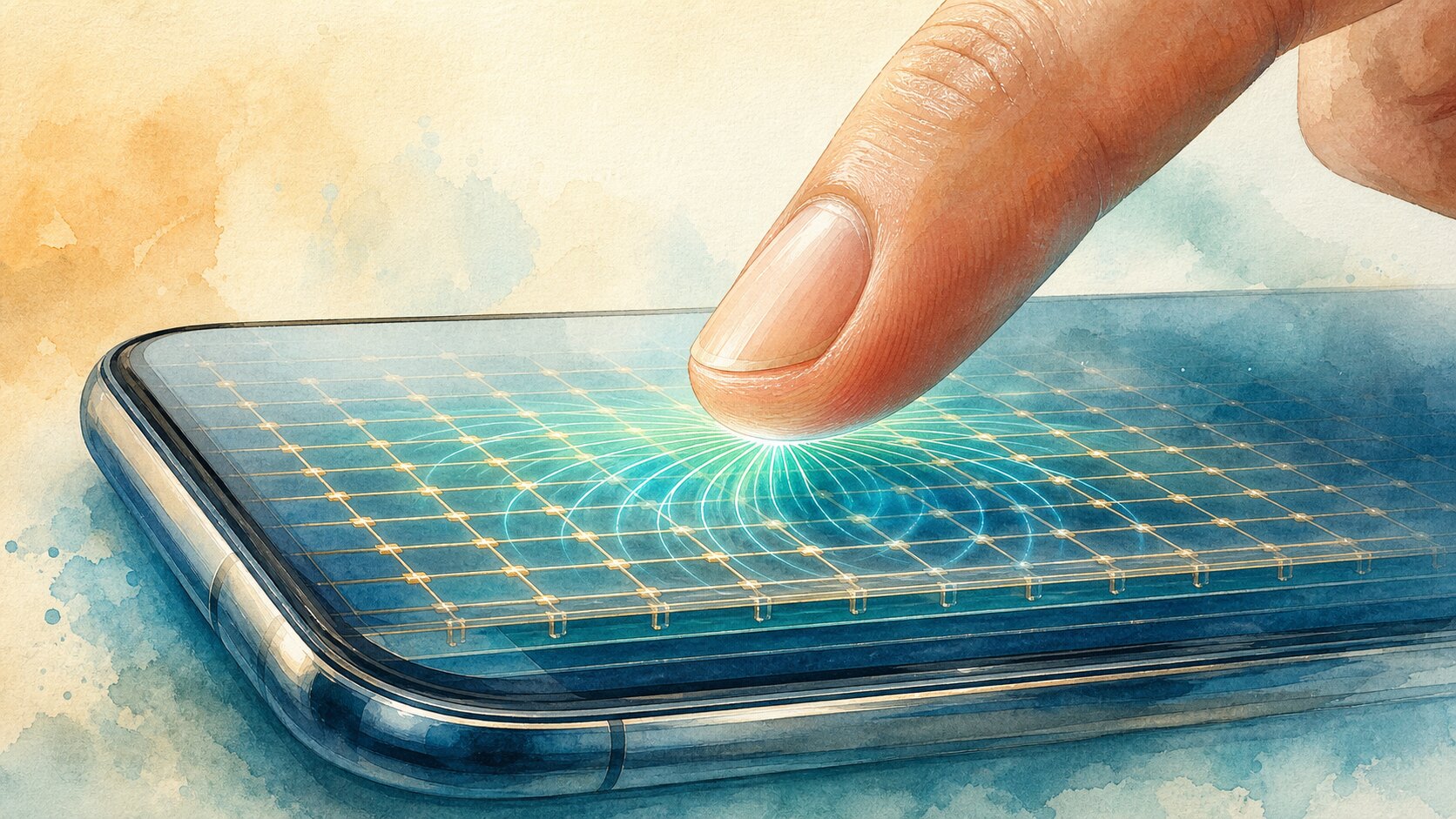
Beneath the glass is a pattern of nearly invisible transparent conductive lines arranged in rows and columns. A controller sends alternating signals through this grid and repeatedly measures how charge is stored or coupled at many locations. It knows the untouched baseline, allowing it to notice changes that are far too small for us to feel.
When a finger reaches one intersection, part of the local electric field couples to the finger and alters the measured capacitance. The controller compares the changes across nearby rows and columns to calculate touch coordinates. By considering the relative signal at several electrodes, it can estimate a position more finely than simply choosing one grid square.
Multi-touch works because the controller scans the grid rapidly and separates clusters of change into distinct contacts. The operating system then connects their positions over time and interprets the pattern as a tap, drag, pinch or rotation. The sensor produces changing coordinates; software decides what those coordinates mean.
Ordinary gloves often fail because a thick insulating layer weakens the coupling between finger and electrode until the change falls below the detection threshold. Gloves with conductive fibers at the fingertips and capacitive styluses work by maintaining an electrical connection to the hand or by producing a sufficiently large field change of their own.
Not every touchscreen uses this principle. Resistive screens, still found in some older navigation and industrial devices, locate pressure when two conductive layers make contact. They can respond to a fingernail or a simple plastic stylus. Capacitive phone screens favor light multi-touch input but care more about the electrical properties of the touching object because their measurement mechanism is fundamentally different.
It is misleading to say that a capacitive screen recognizes human skin and nothing else. Water droplets, a palm and other conductive objects can also disturb its signals. Hardware and algorithms use size, shape, motion and signal strength to reject unwanted contacts. Under the smooth glass, transparent electrodes, measurement circuits and calibration software continuously turn faint electrical traces into usable coordinates.
EDITORIAL RESPONSIBILITY
FactosBrain Editorial Desk
The FactosBrain Editorial Desk researched and reviewed this article under our editorial policy. We assess error reports under our corrections policy.