Look a little closer
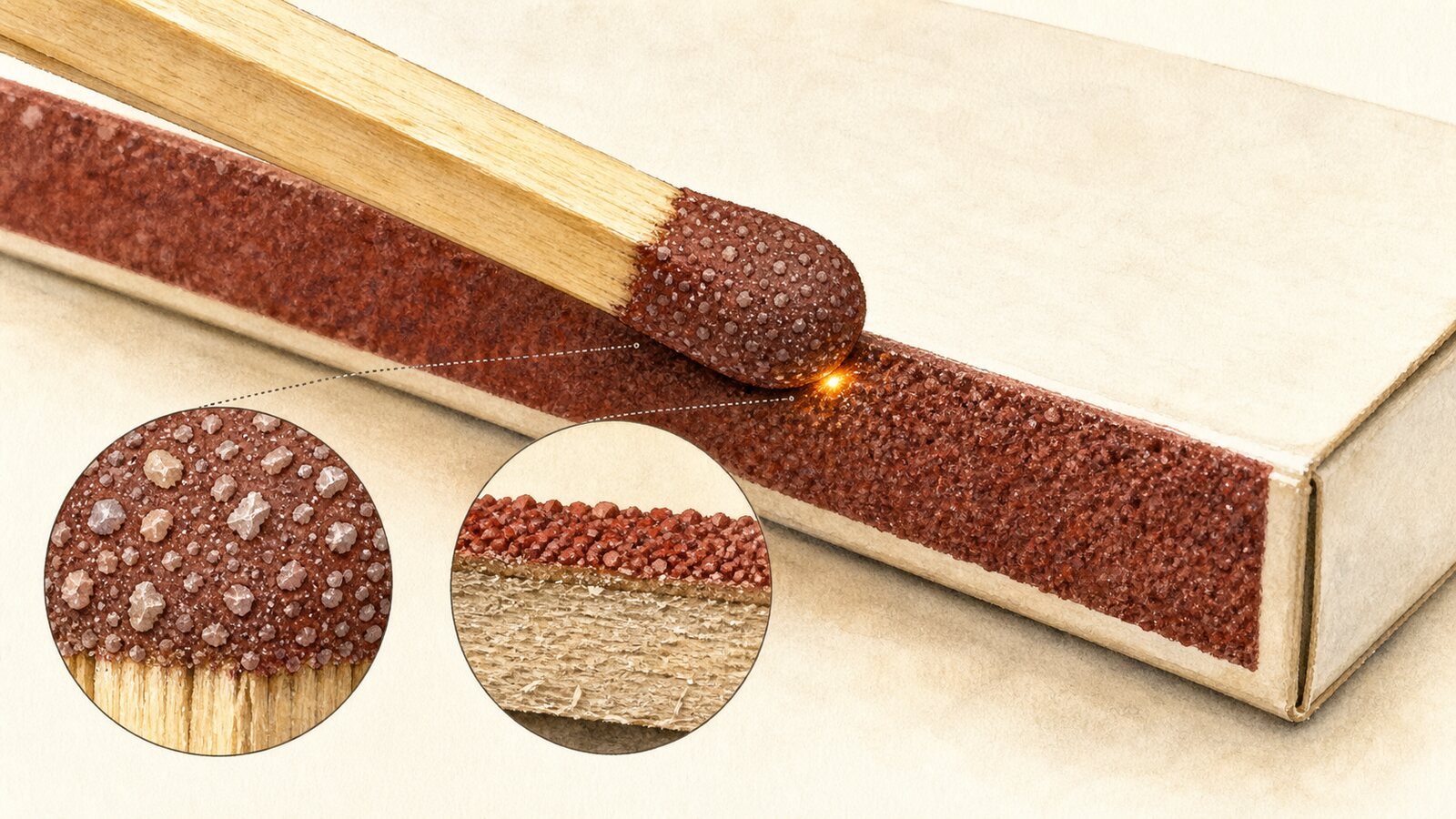
A safety match lights on its box because the ingredients needed for easy ignition are divided between two manufactured surfaces. The head contains potassium chlorate, a strong oxidizer, along with combustible material. The rough strip on the box contains red phosphorus and abrasive particles. A fast stroke supplies heat and creates microscopic contact between the coatings; the first reaction then ignites the head, which passes flame to the wooden splint.
Fire needs fuel, an oxidizer, and enough initial energy to cross an ignition threshold. Rubbing bare wood on a rough board produces heat, but ordinarily not enough to ignite the wood. A safety match concentrates responsive materials so that a brief stroke can cross the threshold while keeping the most sensitive combination apart during storage. Matches jostling inside a box mostly touch head to head. Deliberate use presses a head against the chemically complementary striker.
The brown strip is therefore more than sandpaper. Red phosphorus, a relatively stable allotrope of the element, is bound to the cardboard with abrasives and adhesive. Rough grains grip the match head, convert motion into localized heating, and help tiny amounts from the two coatings meet. Red phosphorus is safer to handle than highly toxic, readily ignited white phosphorus, but at a vigorously rubbed contact with an oxidizing match head it can initiate the ignition sequence.
Potassium chlorate in the head is an oxidizer rather than the main fuel. When the first hot spot forms, it helps supply the oxygen needed for sulfur or other combustible head ingredients to burn rapidly. Binders keep the composite attached, fillers moderate its physical and burning behavior, and dyes give a chosen appearance. A red match head does not prove that it contains red phosphorus. In a conventional modern safety match, the phosphorus is principally in the box strip and the head color may simply come from pigment.
The visible event is a short chemical relay. Abrasion first turns some of the striking motion into heat and exposes fresh points of contact. Red phosphorus at the strip reacts in a microscopic region adjacent to the head's oxidizer, making a hotter ignition point. The chlorate-assisted head composition then burns long enough to ignite the treated surface and wood of the splint. Each stage hands the flame to a larger and slower-burning store of fuel.
Saying that friction alone makes the fire is thus only half right. The stroke supplies energy, but it also brings two separated coatings together at the small points where that energy is concentrated. A worn or wet striker can fail because its abrasive and phosphorus-bearing surface no longer creates good hot contacts. A damp head spends heat evaporating water and disrupts the transfer among its ingredients. The dry match and its strip function as paired components of one ignition system.
Safety does not mean immunity to fire. A match head still contains an oxidizer and combustible substances, so abnormal heat, severe impact, damage, or careless storage can be hazardous. Potassium chlorate is a powerful oxidizing material, especially dangerous when removed and mixed with incompatible substances. Commercial matches are meant to be used as controlled finished composites whose particle sizes, binders, and coating thicknesses were set in manufacturing. Dismantling them defeats the separation on which their safer behavior depends.
That separation emerged from a history of harmful friction matches. Nineteenth-century products using white phosphorus in their heads exposed factory workers to severe poisoning and destructive jaw disease. In the 1850s, manufacturers including Swedish match works developed commercial safety matches using much less toxic red phosphorus on an external striking surface. The major advance was not just substituting one form of phosphorus for another; it was moving a sensitive ignition ingredient away from the head until the moment of use.
Not every match makes the same tradeoff. So-called strike-anywhere matches include a more self-contained initiating composition in the head so that an appropriate rough surface can light them without the special box strip. A standard safety match instead works best when head oxidizer, striker phosphorus, and frictional heating meet together. Its flame does not spring from rubbing as a single cause. It comes from briefly reconnecting a chemical system that the package deliberately keeps divided.
EDITORIAL RESPONSIBILITY
FactosBrain Editorial Desk
The FactosBrain Editorial Desk researched and reviewed this article under our editorial policy. We assess error reports under our corrections policy.