Look a little closer
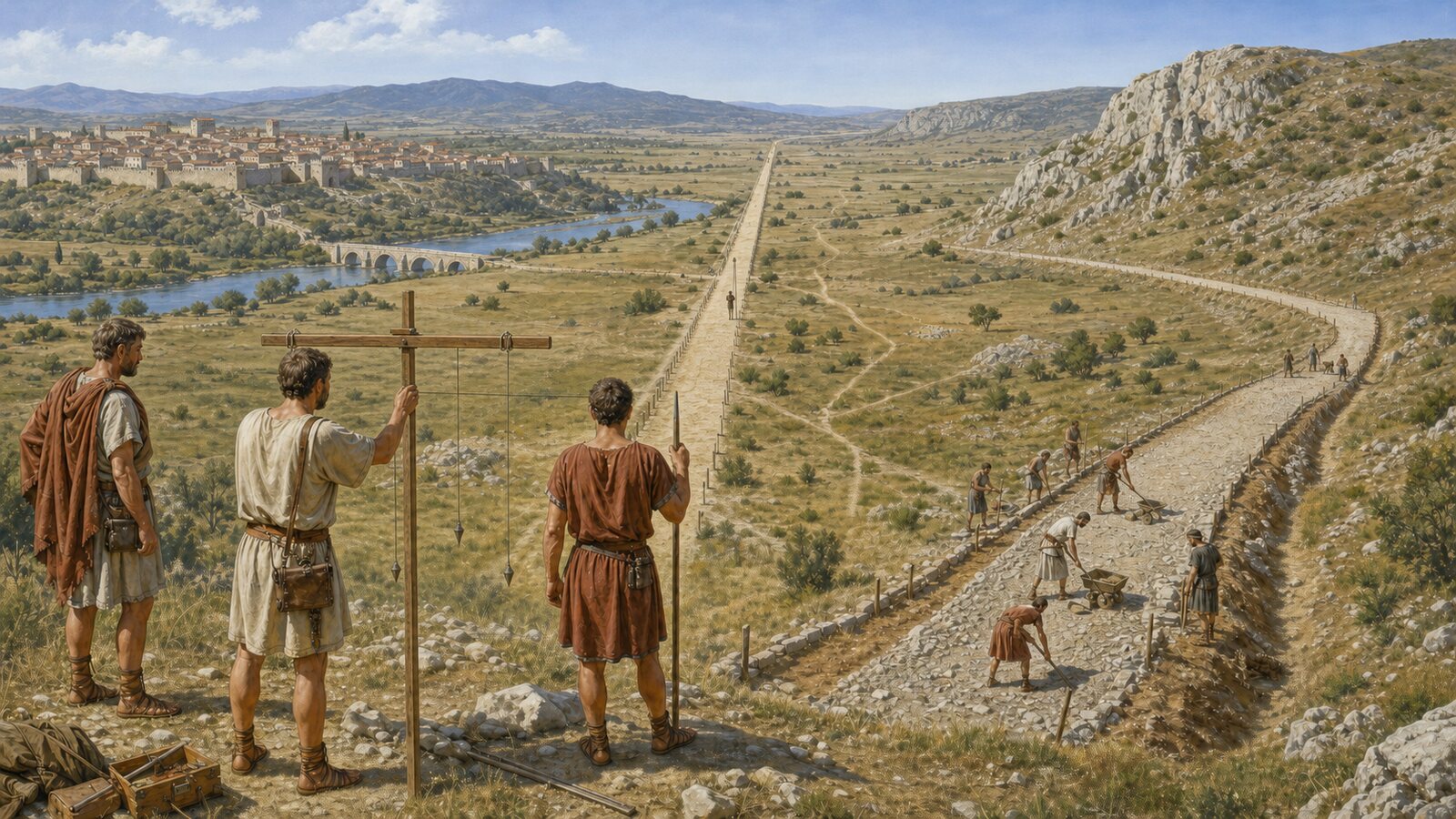
A Roman aqueduct was not usually a giant pump that lifted water uphill. It was a long watercourse that used gravity to carry water gradually downhill. Engineers selected springs or upland sources above the destination and surveyed a route with a very gentle, continuous fall. The water did not need a dramatic drop; it needed a reliable slope all the way to the city.
Most of an aqueduct was not the spectacular row of high arches people often picture. Much of the route could follow the contour of the land in covered channels, tunnels, or low walls. Arches were useful where a channel had to cross a valley or river while staying at the required height. The famous bridge-like sections were often only a visible part of a much longer system.
The gradient had to be carefully controlled. If it was too steep, fast water could damage the channel or stir up sediment; if it was too shallow, the flow might not work well. Builders sometimes made a route longer in order to follow suitable contours, and sometimes bored tunnels through hills. Systems such as the aqueduct serving Nîmes, including the Pont du Gard, depended on maintaining that subtle descent over a long distance.
Arches were not the only way to cross difficult terrain. In some places, an inverted siphon carried water down one side of a valley in pipes; pressure could then drive it up the other side, provided the route and materials could withstand it. Settling tanks helped remove sediment, and distribution structures and valves managed flow in the city. An aqueduct was a system of source, channel, tunnel, pipe, maintenance, and distribution, not a single bridge.
The achievement of Roman aqueducts was therefore not a secret method for making water flow upward. It was the disciplined use of gravity, surveying, materials, and maintenance. The channels needed cleaning and repair, and water still had to be allocated among baths, fountains, and other users. High arches remain the most visible symbol, but they make sense only as one part of that larger hydraulic system.
EDITORIAL RESPONSIBILITY
FactosBrain Editorial Desk
The FactosBrain Editorial Desk researched and reviewed this article under our editorial policy. We assess error reports under our corrections policy.