Look a little closer
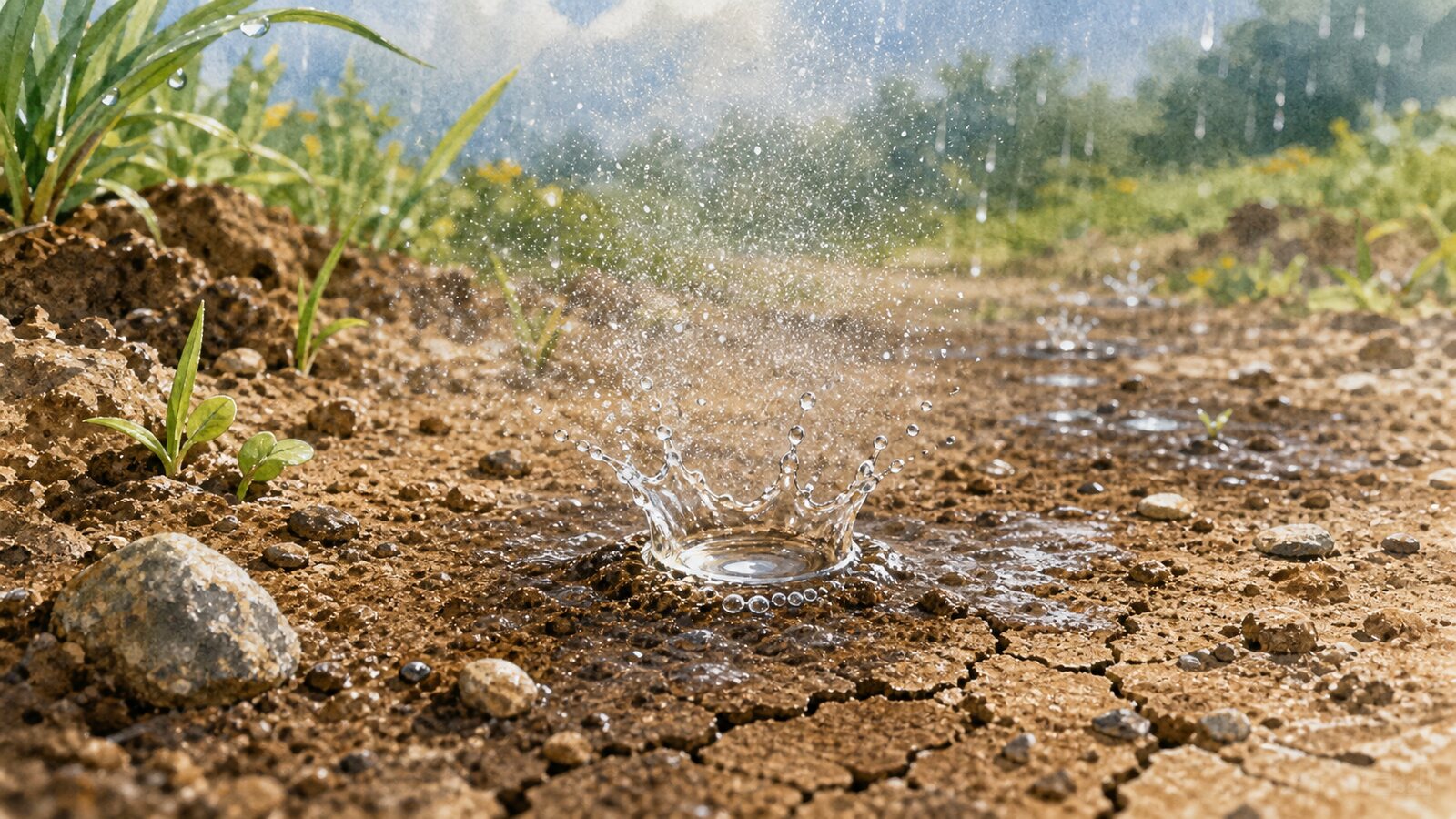
The earthy smell after rain does not come from odor added to the water in the cloud. It appears when the first drops strike dry soil and stone, launching accumulated volatile compounds in microscopic aerosols that drift through the air. The overall scent is called petrichor, and its local mixture may include microbially produced geosmin, plant-derived oils, and other compounds held near porous surfaces.
Australian researchers Isabel Joy Bear and Richard Thomas introduced the word petrichor in a 1964 Nature paper. They investigated the characteristic odor released when moisture reached clays and rocks that had been exposed to warm, dry conditions, and extracted a yellowish oil associated with it. The name combines Greek roots for stone and the mythical fluid in the veins of the gods. It now labels a sensory mixture, not a single pure chemical.
One of that mixture's most recognizable molecules is geosmin, a volatile bicyclic terpene whose name literally refers to an earthy smell. Soil microorganisms, notably several Streptomyces bacteria, make it as part of their metabolism. Rain does not manufacture geosmin on contact; it mobilizes material that was already present. Human noses are extraordinarily responsive to it—the American Chemical Society reports detection in air around five parts per trillion—so a minute airborne dose can dominate the impression of wet earth.
During a dry interval, volatile plant products and microbial compounds can remain adsorbed to mineral grains or lodged in tiny spaces close to the surface. Those spaces also contain air because the ground is not yet saturated. A long rainless spell can therefore prepare both a store of odorants and the physical conditions for releasing them. Soil composition, vegetation, microbial communities, temperature, and previous weather vary, so there is no universal petrichor recipe and not every shower smells alike.
High-speed experiments have revealed the tiny delivery mechanism. When a drop spreads across a wettable porous surface, air escaping from the pores can become trapped beneath the advancing water film. The resulting microbubbles rise through the drop and burst at its surface. Each burst ejects a spray of droplets small enough to become airborne, carrying dissolved or suspended material from the ground. The process resembles sea-spray production by bursting bubbles, but here a single raindrop and the air in soil pores form the miniature atomizer.
A 2015 Nature Communications study tested this effect on 16 soils as well as engineered porous materials and liquids with different impact conditions. Aerosol output depended on how easily the surface wetted, the structure of its pores, and the drop's impact speed. An impact can be too gentle to trap and burst many bubbles, while a very energetic splash or a surface that rapidly becomes flooded may not maximize the same fine-bubble route. Light or moderate rain can be especially effective on some dry soils, but that is a condition-dependent result rather than a promise that every drizzle will smell strongest.
Once emitted, fine aerosols travel with wind and near-ground turbulence. Water in a microscopic droplet may partly evaporate while volatile molecules remain available to reach olfactory receptors. The same mechanism can disperse mineral particles, microbial fragments, or spores as well as scents, which is why it matters beyond pleasant weather memories. Petrichor is not merely a slow evaporation from uniformly wet ground; mechanical impact creates a fast bridge from pores in the soil to the surrounding atmosphere.
A sharp or electrical odor noticed before the first drops may have a different source. Downdrafts associated with storms can transport ozone and other air from aloft, producing a sensation that people also call the smell of rain. Classic earthy petrichor becomes strongest after water actually contacts a dry surface. Forest litter, cultivated soil, a rocky path, and warm pavement smell different because they hold different organisms and organic compounds and present different pore structures to the falling water.
As rain continues, pores fill, stored compounds wash away or dilute, and the initial burst of aroma often fades. A later dry period lets biological products and plant oils accumulate near mineral surfaces again. The smell after first rain is therefore a sequence: dry ground stores a varied chemical inventory; drops trap pore air; bursting microbubbles make aerosols; air currents deliver them; and a highly sensitive nose detects traces of geosmin among the mixture. What feels like the scent of water is really a brief exchange between weather, soil, microbes, plants, and air.
EDITORIAL RESPONSIBILITY
FactosBrain Editorial Desk
The FactosBrain Editorial Desk researched and reviewed this article under our editorial policy. We assess error reports under our corrections policy.