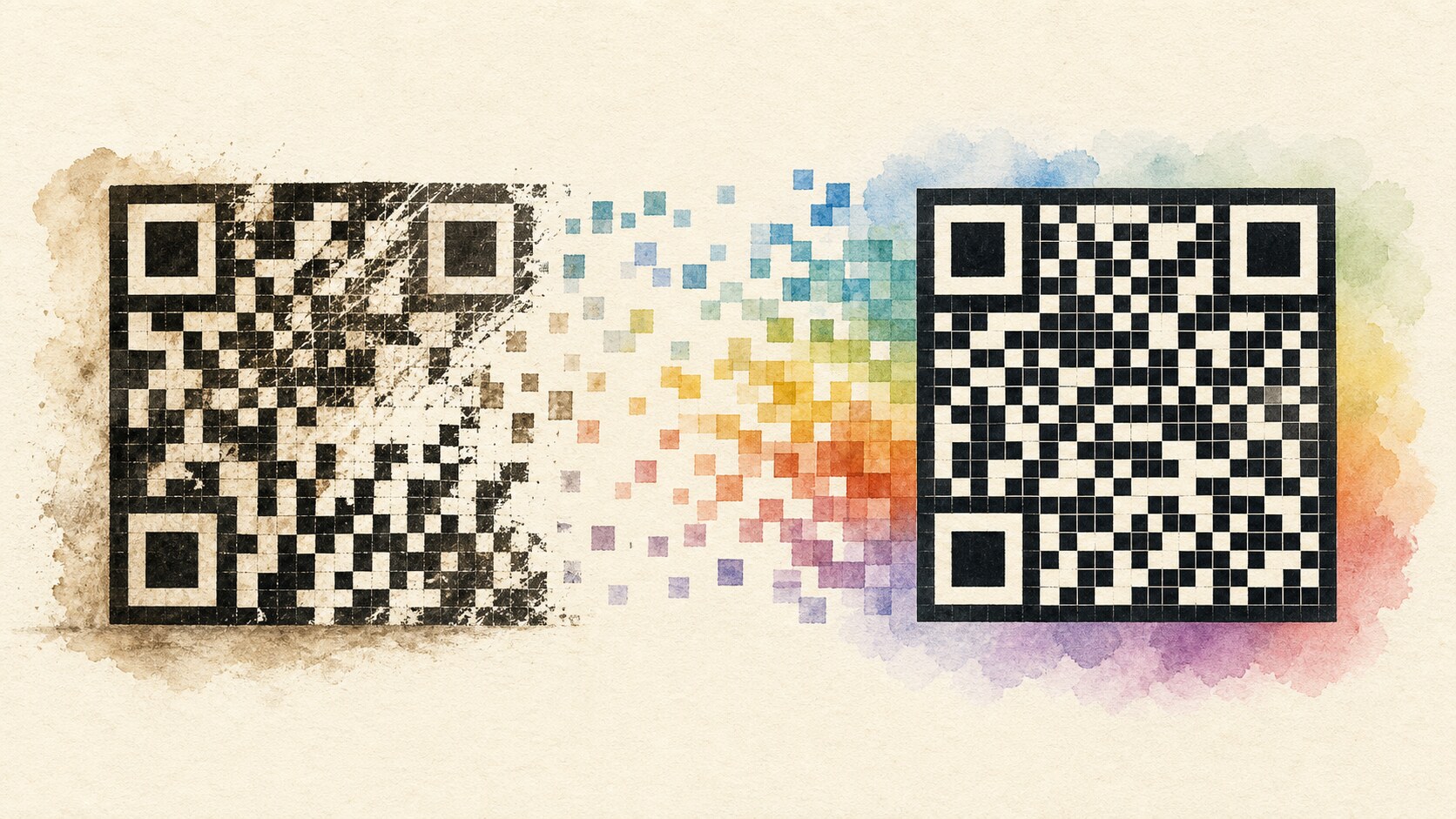
A scratched or dirty QR Code can remain readable not because it stores the same picture several times, but because it carries error-correction codewords calculated from the original data. A scanner can use that redundancy to recover some values that were missed or read incorrectly.
Characters are converted into a grid of black and white modules and divided among data blocks. Reed-Solomon parity codewords are added to each block. A decoder tests mathematical relationships that should hold among the received codewords, estimates error locations and values, and reconstructs the original block when the corruption stays within its capability.
QR Codes offer four correction levels: L, M, Q and H. DENSO WAVE describes approximate codeword recovery rates of 7, 15, 25 and 30 percent respectively. A stronger level provides more resilience, but at the same symbol version and size it leaves less capacity for the actual message.
The large squares in three corners are finder patterns that reveal orientation and scale before message decoding begins. Alignment and timing patterns help fit the module grid, while the blank quiet zone around the symbol separates it from its surroundings. Severe damage to these structures can prevent a scan even when the apparent data loss is small.
Level H does not mean any 30 percent of the visible square may be covered safely. The percentages concern codewords rather than simple surface area, and results depend on how damage falls across blocks as well as focus, contrast, print size and essential patterns. Beyond correction capacity, decoding will usually fail, but error correction cannot logically guarantee detection of every over-limit corruption.
A logo can cover the center of some codes not because that region was reserved as blank, but because correction capacity may absorb the hidden modules while structural patterns and margins remain intact. Important codes should be tested as final physical objects under realistic lighting and distance on several devices. A successful scan alone does not prove that its destination or message is trustworthy.
Error correction recovers data from a damaged carrier; it does not authenticate that data. If someone replaces an entire QR Code with another valid one, the substitute may scan perfectly. The format's resilience comes from parity information working with structural landmarks, while checking whether a link is genuine remains a separate security task.
EDITORIAL RESPONSIBILITY
FactosBrain Editorial Desk
The FactosBrain Editorial Desk researched and reviewed this article under our editorial policy. We assess error reports under our corrections policy.