Look a little closer
Pressure-sensitive tape bonds immediately because light pressure deforms its adhesive into microscopic surface texture, creating a large area of intimate contact without waiting for a solvent to evaporate or a chemical cure to finish. The adhesive is a tuned viscoelastic polymer: it can flow enough during application to conform, yet responds elastically and dissipates energy when the tape is pulled away.
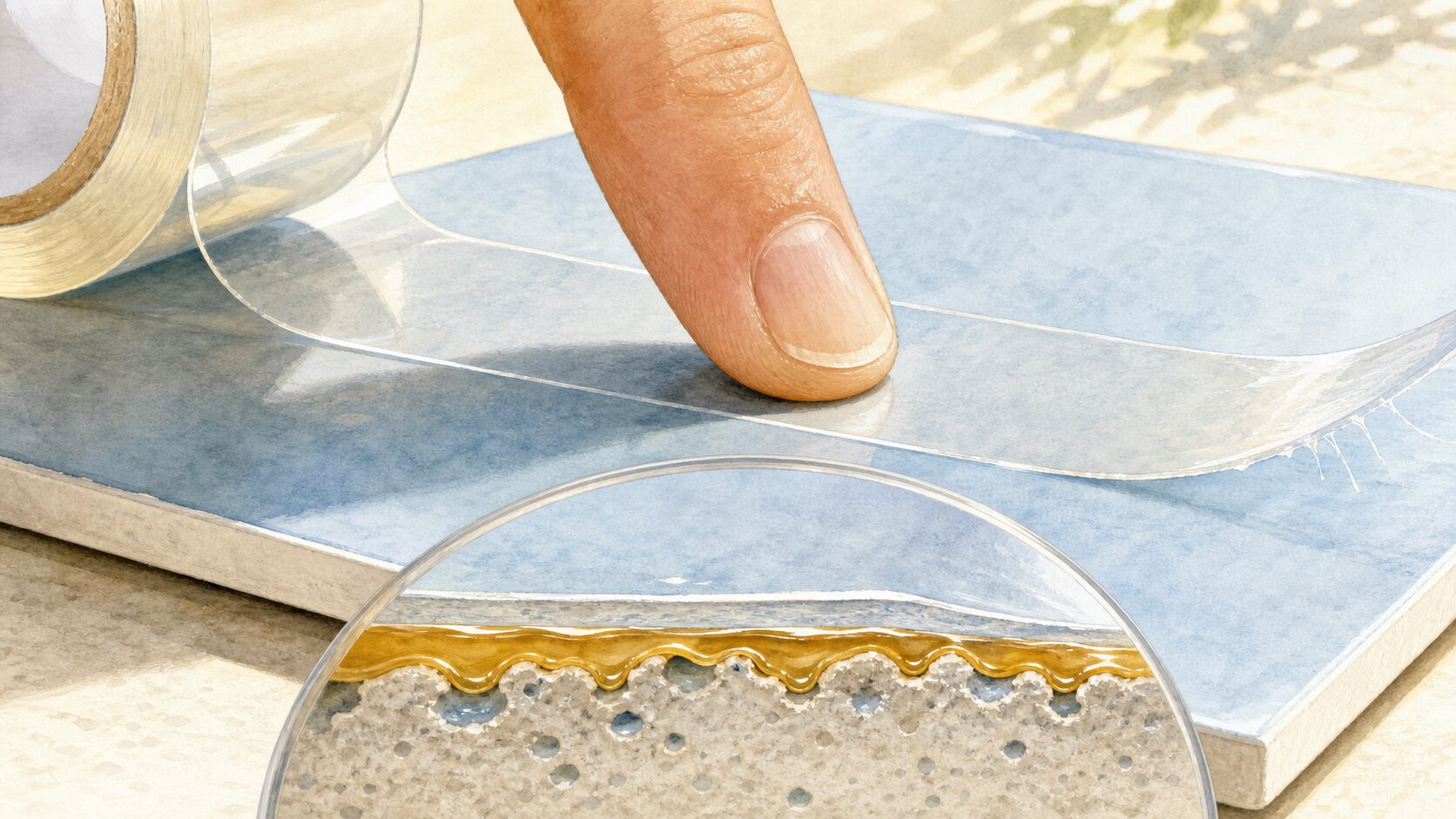
Paper, glass, and a desktop may look smooth, but at microscopic scale they contain peaks and valleys. Bringing two rigid solids together leaves most of the apparent area separated by tiny gaps and air. A soft tape adhesive deforms under finger pressure, displaces air, and spreads into those irregularities. Adhesive scientists call this process wetting or wet-out, but no water is produced; the term describes an adhesive establishing intimate real contact with the substrate.
Once molecules approach closely, dispersion forces, polar interactions, and other surface-specific attractions can act across the interface. Each interaction is small, but their contribution over a large contact area becomes useful adhesion. A clean, higher-surface-energy material such as glass or many metals can be easier for a formulation to wet than an oily, dusty, damp, or low-surface-energy plastic. On a rough wall, the adhesive must also be soft and thick enough to reach into the valleys rather than rest only on the highest asperities.
An adhesive that behaves only like a thin liquid would squeeze aside, creep, and fail under a sustained load. One that is too stiff cannot conform during application and has poor tack. Pressure-sensitive formulations balance the two. Polymer chain length, entanglement, crosslinking, and tackifying resins allow slow application pressure to produce contact while preserving enough cohesive strength and elastic response to resist shear and detachment. Different products deliberately place that balance at different points.
Removing tape consumes energy beyond breaking attractions at a single sharp interface. Voids can form in the thin adhesive layer, while polymer-rich bridges stretch into fibrils behind the advancing peel front. Viscoelastic deformation converts part of the mechanical work into heat. The measured peel energy can consequently be far greater than the reversible molecular work of adhesion alone. Peel angle, speed, and temperature change how much time the polymer has to rearrange, which is why the same strip can feel different when removed slowly, snapped quickly, warmed, or chilled.
Bond strength can also build with dwell time. Finger pressure creates fast initial contact, but polymers may continue moving into smaller surface valleys and relaxing concentrated stress over minutes or hours. This is why application instructions may call for firm rubbing and a wait before loading the bond. At low temperature the layer may become too glassy and stiff to wet the surface; at excessive heat it can soften enough to creep slowly under load. Products therefore have separate application and service temperature ranges. Time cannot repair every mismatch: contamination, insufficient pressure, or incompatible surface energy can prevent adequate wet-out from the start.
A roll needs another engineered interface so it does not become one solid block. The nonadhesive back of single-sided tape can carry a low-surface-energy release coating, or the backing material itself can be selected for controlled unwind. The adhesive should wet its intended substrate readily while separating from that back surface at a predictable force. Double-sided and unsupported transfer tapes instead use release liners to protect exposed adhesive until each side is applied.
Clean removal depends on cohesion as well as adhesion. If the adhesive layer holds together more strongly than its interface holds the substrate, it can depart as one film. Heat, ultraviolet exposure, oxidation, plasticizer migration, and long dwell can change the polymer or strengthen contact until the layer splits internally and leaves residue. A weak substrate such as paper may tear before the adhesive releases. The strongest possible tape is therefore not automatically the best one for a removable label, conservation mount, skin patch, or painted wall.
Industry tests separate properties that everyday language lumps together: initial tack, peel force at a controlled angle and speed, and shear holding power under sustained load. Rubber-based packaging tapes, weather-resistant acrylic systems, and silicone adhesives for demanding temperatures or surfaces use different chemistries because no single balance fits every task. Tape is not simply glue that stays permanently wet. It is a thin polymer system engineered to follow a surface under slow pressure and absorb substantial energy under the faster deformation of removal.
EDITORIAL RESPONSIBILITY
FactosBrain Editorial Desk
The FactosBrain Editorial Desk researched and reviewed this article under our editorial policy. We assess error reports under our corrections policy.