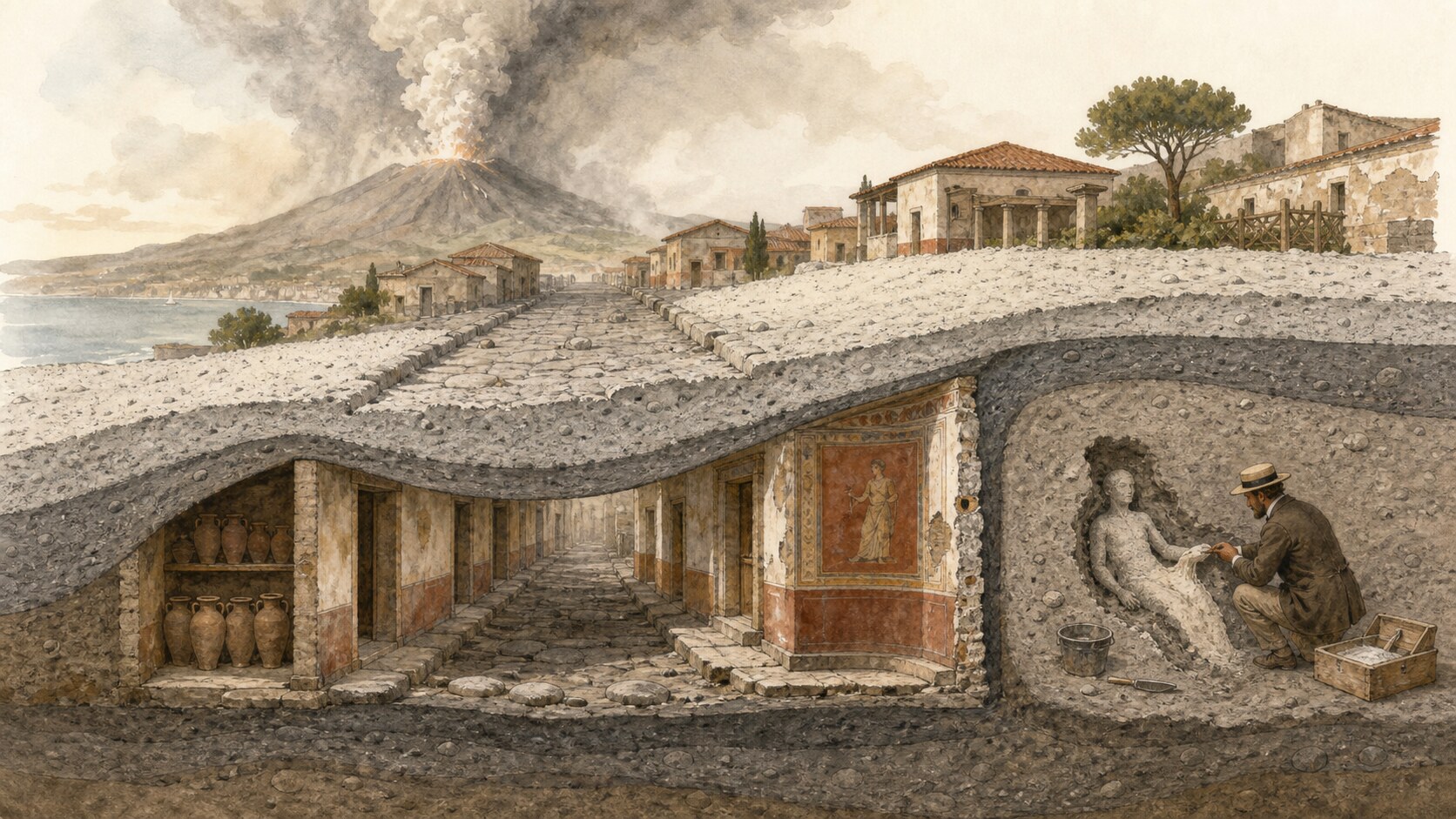
Pompeii survived for nearly two millennia not because time stopped perfectly in a single instant. During the 79 CE eruption of Vesuvius, falling pumice and ash, followed by deposits from hot pyroclastic density currents, buried the city in several layers. That thick cover isolated buildings and traces of daily life from surface weather and much later development.
Early in the eruption, accumulating pumice and ash became heavy enough to collapse many roofs. Burial was therefore destructive, not gentle packaging. Even so, deposits filled spaces around walls, rooms and objects and fixed much of their spatial arrangement. Later ash-rich currents entered additional gaps and produced hardened layers across the city.
The cover blocked sunlight, plant roots and repeated construction. As a result, Pompeii retained not only isolated artifacts but broad relationships among homes, streets, shops, workshops and wall paintings. UNESCO emphasizes this extensive urban context and the rich evidence it provides for Roman society and everyday life across Pompeii, Herculaneum and the associated villas.
The famous victim forms are not whole bodies turned to stone. After soft tissue decomposed, voids and bones remained inside hardened volcanic deposits. In the nineteenth century, excavator Giuseppe Fiorelli systematically used a method of pouring plaster into those cavities, preserving poses and surface impressions such as folds in clothing. Conservators have since also used resins and imaging methods for selected remains.
Preservation was never uniform. Buildings failed during the eruption, and evidence suggests that survivors or looters later removed some objects. Organic materials disappeared under many conditions. Once excavated, walls and paintings are again exposed to air, sunlight, rain and temperature changes, which can damage them quickly. Removing the protective burial layer therefore creates a continuing conservation obligation.
Pompeii is an unusual result of a disaster that destroyed and protected at the same time. Rapid burial locked much of the urban layout in place, and long isolation underground reduced later weathering. The site is not a flawless photograph of one frozen day; it is an archaeological record with losses and alterations that nevertheless preserves Roman homes, work, meals and streets in exceptionally broad context.
EDITORIAL RESPONSIBILITY
FactosBrain Editorial Desk
The FactosBrain Editorial Desk researched and reviewed this article under our editorial policy. We assess error reports under our corrections policy.