Look a little closer
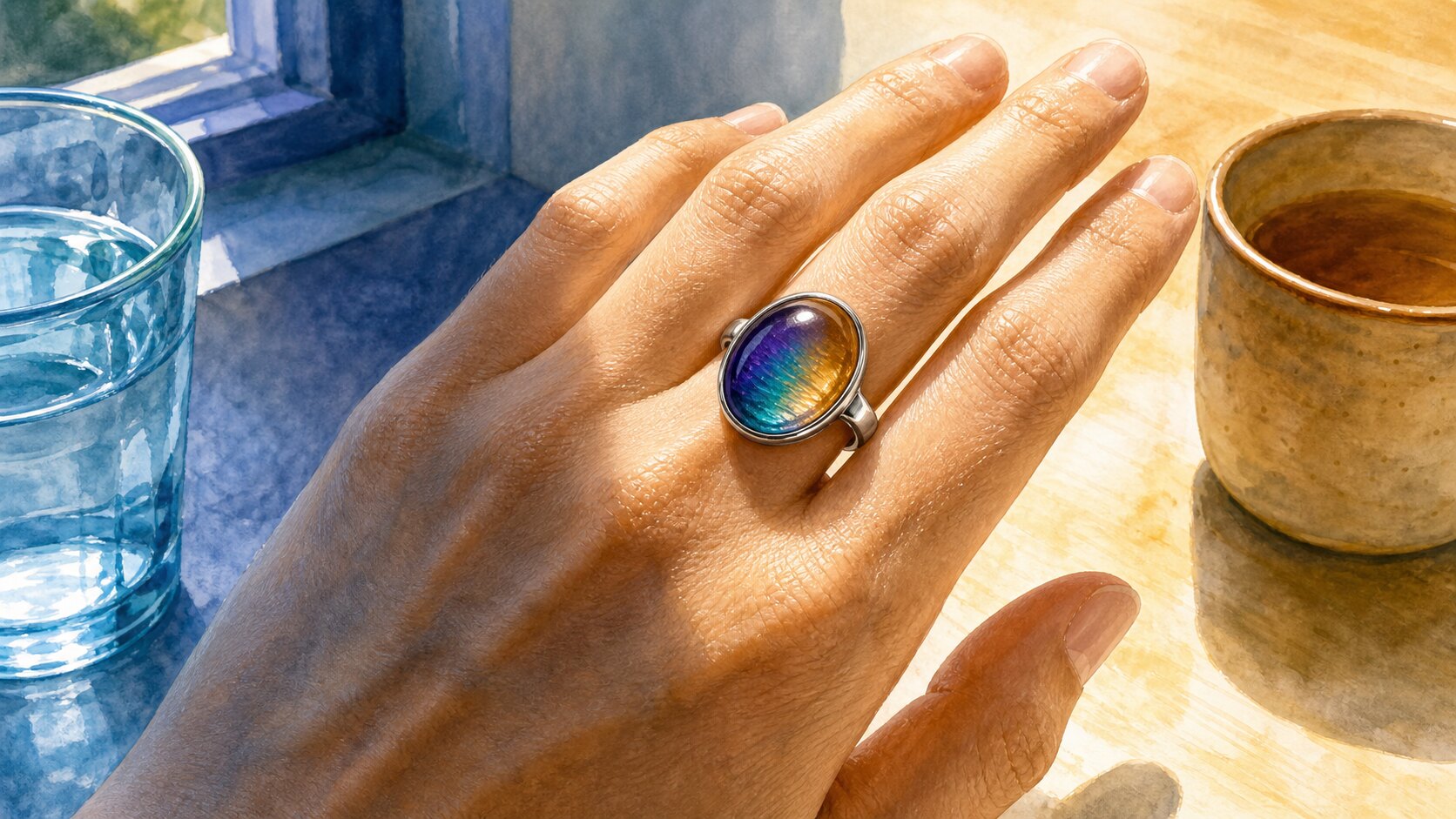
A mood ring does not sense emotion directly. It is a small liquid-crystal thermometer whose reflected wavelength changes with the temperature of the wearer's finger. A sealed thermochromic layer sits beneath the apparent stone; heating or cooling changes the spacing of its helical molecular structure, so different bands of visible light return to the eye. Emotion can influence peripheral blood flow, but too many other factors change finger temperature for one color to identify a particular feeling.
A liquid crystal is a state of matter that can flow like a liquid while retaining some crystal-like order in molecular orientation. Mood jewelry commonly uses a thermotropic type called cholesteric, or chiral nematic, liquid crystal. Long molecules point in a similar direction within a layer, but that direction rotates slightly from one layer to the next, producing an overall helix. Thermotropic means that temperature changes this ordered state; the stone is not being alternately dyed by several pigments.
The distance over which the orientation completes one turn is called the pitch. When white light enters this periodic structure, a narrow wavelength band related to the pitch and refractive index is selectively reflected, while much of the remaining light passes through. Reflection at longer visible wavelengths can look red, intermediate wavelengths green or turquoise, and shorter ones blue or violet. A dark backing absorbs much of the transmitted light, making the selected reflection stand out.
Temperature alters intermolecular forces and the helical pitch. Many commercial mixtures are designed so that, within their useful range, the displayed color progresses from red through green toward blue as temperature rises, but composition determines the exact sequence and thresholds. Below or above the active liquid-crystal range, the layer may no longer reflect a strong visible band and can look dark or muddy. The printed meaning chart supplied with one ring is not a universal law for all thermochromic mixtures.
The measured quantity is also local layer temperature, not core body temperature. Heat from the finger must conduct through the metal setting and glass or plastic cover, while room air, sunlight, a cold drink, or warm water exchanges heat with the ring at the same time. A loose fit reduces contact, and a thick setting or newly worn ring responds slowly. The same person in the same mood can therefore see a different color outdoors in winter than in a warm room.
The marketing link to mood is not entirely disconnected from physiology, but it is profoundly nonspecific. Sympathetic stimulation from mental stress or pain can temporarily constrict vessels and reduce blood flow and temperature in a warm finger; relaxation or warming may shift circulation in the other direction. Yet excitement, fear, concentration, and pleasure have overlapping and individually variable autonomic patterns. Exercise, caffeine, ambient temperature, vascular differences, and hand position can create similar changes. No color uniquely means love, anxiety, or calm.
Viewing angle can alter the appearance as well. Selective reflection from a helical liquid crystal depends partly on the angle at which light enters and leaves the layers, so tilting the hand may shift hue or brightness even before the temperature changes. Aging adds more variation: a seal can fail, or ultraviolet light, moisture, and excessive heat can damage the thermochromic layer. Two rings showing different colors on adjacent fingers are more likely to differ in formulation, contact, orientation, or condition than to have detected two simultaneous emotions.
The underlying effect has uses beyond novelty jewelry. Calibrated thermochromic strips can map skin or surface temperature, and engineers use liquid crystals to visualize heat-transfer patterns in airflow and machinery experiments. Liquid-crystal displays share the broad idea of controlling light through molecular orientation, but an LCD typically uses electric fields and polarizers to modulate pixels. It is not simply a grid of mood-ring stones. Reliable measurement comes from calibrating a particular mixture's color against temperature under controlled viewing conditions.
The real wonder of a mood ring is therefore optical materials science, not mind reading. Finger and environment set the layer's temperature; temperature adjusts the helical pitch; and pitch selects the wavelength reflected to the eye. Emotion is only one possible contributor to the first step, while the emotional color key is an invented interpretation. The ring is best understood as a compact, visually striking translator of a few degrees of heat into color.
EDITORIAL RESPONSIBILITY
FactosBrain Editorial Desk
The FactosBrain Editorial Desk researched and reviewed this article under our editorial policy. We assess error reports under our corrections policy.