Look a little closer
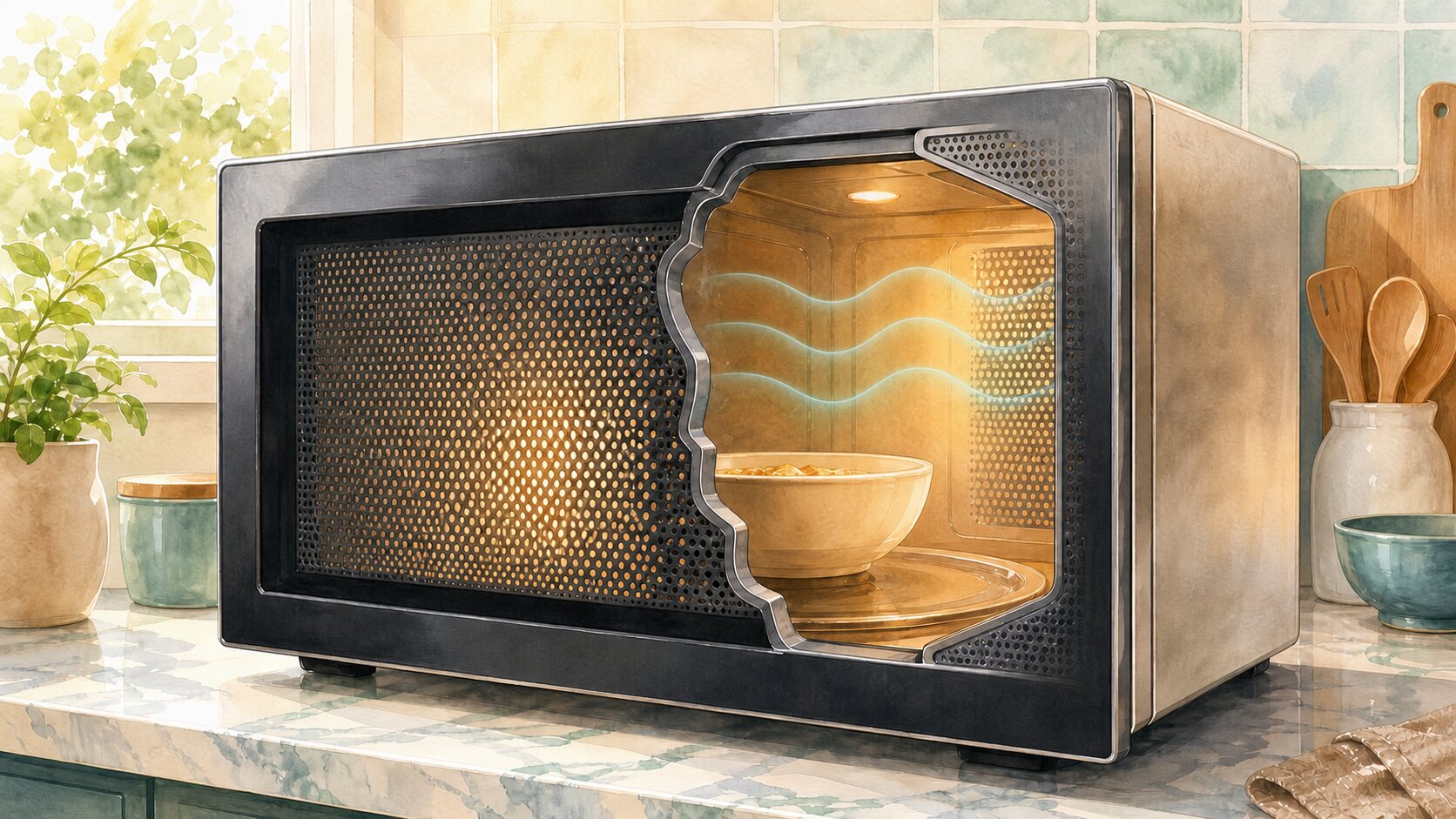
The perforated screen in a microwave-oven door strongly reflects and attenuates microwaves whose wavelength is far larger than its holes, while visible light with a far shorter wavelength can pass through. Its selectivity is not simply a matter of metal being opaque. The connected conducting screen, aperture dimensions, screen thickness, door-edge seals, and safety interlocks form one engineered containment system.
Many household ovens operate near 2.45 gigahertz. In free space, that frequency corresponds to a wavelength of about 12 centimeters, tens of times larger than the millimeter-scale openings commonly seen in a door screen. Visible wavelengths are roughly 400 to 700 nanometers, thousands of times smaller than the same openings. The screen therefore presents a very different electromagnetic obstacle to the heating field than it does to the light coming from the oven lamp and food.
When a microwave field reaches a conducting metal surface, its electric field drives mobile charges and establishes currents near the surface. The field produced by those currents largely cancels transmission through the metal and returns most of the energy toward the cooking cavity. Although the door screen is perforated, its metal regions remain electrically connected and provide paths for these induced currents. A clear plastic window by itself would not supply the same shielding behavior.
Each opening can also be treated approximately as a very short, narrow waveguide. A waveguide supports propagating modes only above cutoff frequencies set by its geometry. Below cutoff, the field does not travel down the channel as an ordinary propagating wave; its amplitude decays rapidly with distance. If the aperture is sufficiently small relative to the oven wavelength, the 2.45-gigahertz field is well below the aperture's lowest useful propagation mode and is heavily attenuated. Diameter is not the only variable: thickness, shape, spacing, array pattern, conductivity, and the surrounding layers all affect leakage, so manufacturers test the assembled screen rather than rely on a slogan about hole size.
Visible light encounters the opposite scale relationship. Its wavelength is tiny compared with each opening, allowing many rays to traverse the empty area and reach an observer. The metal's open-area fraction blocks some light, and a dark finish can reduce distracting reflections, which is why the window looks dimmer than ordinary glass. Enough light still passes through thousands of apertures to reveal the food's outline and movement. From normal viewing distance, the visual system integrates the broad scene behind the small dark dots instead of attending to every hole.
It is too absolute to say that any hole smaller than a wavelength passes no energy. Electromagnetic fields through small apertures are not exactly zero, and their attenuation depends on dimensions, material, number of holes, nearby structures, and possible coupling or resonances. The viewing screen is consequently one component of a larger shield that includes the metal cavity, transparent protective layers, door frame contacts, gaskets, and often microwave-choke features. A result that is safe for a complete tested door cannot be inferred from an isolated piece of perforated metal.
The door perimeter can be a more demanding leakage route than the broad window. A movable door cannot be welded continuously to the cavity, so designers use overlapping conductive surfaces and choke structures shaped to reflect or cancel fields that enter the seam. Independent interlocks stop microwave generation as the latch is released. In the United States, the FDA performance standard requires at least two operative safety interlocks and limits emission measured at specified distances and conditions. Those limits apply to the finished oven, not merely to the screen material.
Small visible holes also do not make arbitrary home repairs safe. One 1970s door-screen patent tested leakage over aperture diameters from 0.6 to 1.8 millimeters, then proposed holes no larger than 1.2 millimeters with more than 40 percent open area for its particular thin aluminum construction. That is a concrete example of balancing visibility and shielding, not a universal specification for every oven. Current materials and seal geometries vary by model. A bent door or damaged hinge, latch, or sealing surface can change the tested arrangement without leaving an obvious hole in the mesh. The FDA advises against using an oven whose door does not close firmly or is bent, warped, or otherwise damaged, and recommends qualified evaluation rather than improvised alteration.
A microwave door is thus a window for light and an array of below-cutoff passages for the heating field. The roughly 12-centimeter microwave induces currents in the connected metal and decays strongly in the tiny apertures; visible light only hundreds of nanometers long can cross the open spaces. Seeing dinner rotate while the field remains contained is the combined result of wavelength-scale screen design, the rest of the door seal, and interlocks that turn the source off when access begins.
EDITORIAL RESPONSIBILITY
FactosBrain Editorial Desk
The FactosBrain Editorial Desk researched and reviewed this article under our editorial policy. We assess error reports under our corrections policy.