Look a little closer
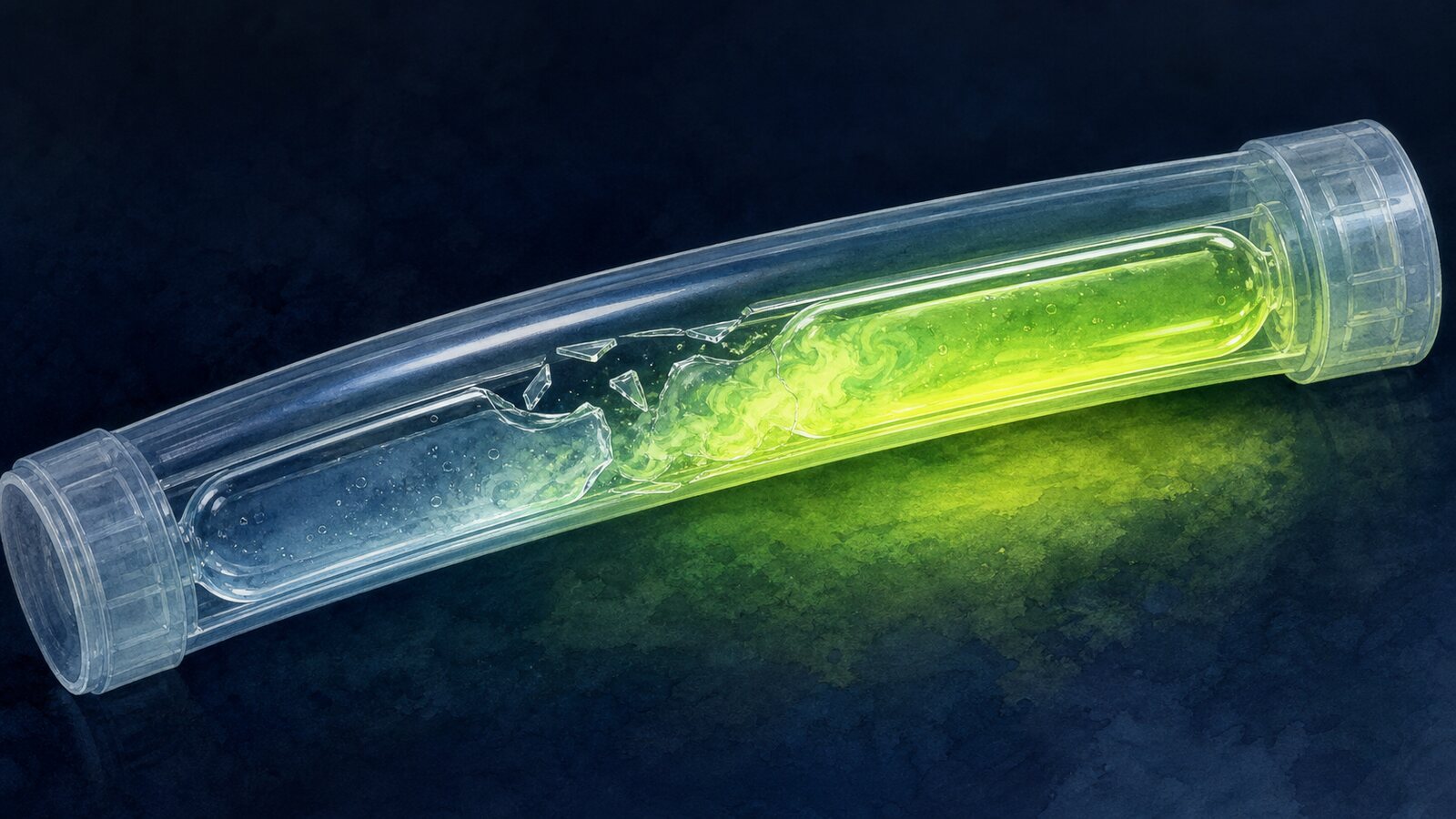
A glow stick needs no battery because it transfers energy from a chemical reaction into an electronically excited fluorescent dye. When the dye returns to its ordinary state, it emits that energy as visible light, a process called chemiluminescence. The snap heard when the stick is bent is not an electrical switch. It is the breakage of a thin glass ampoule inside the still-sealed plastic tube, allowing two previously separated solutions to mix.
In a common disposable design, the flexible outer tube contains an oxalate ester and a fluorescent dye in solution, while the inner glass vial holds hydrogen peroxide solution. Physical separation prevents the main reaction during storage. Flexing the plastic breaks only the vial; shaking spreads its contents through the surrounding liquid and creates a large mixing interface. The intact outer shell keeps both the liquid and the enclosed glass fragments inside, which is why opening a used stick is not part of its intended operation.
Once mixed, hydrogen peroxide oxidizes the oxalate ester through a sequence of short-lived intermediates. Evidence now identifies 1,2-dioxetanedione, an unstable and highly energetic four-membered ring, as the key high-energy intermediate in peroxyoxalate chemiluminescence. Researchers debated the detailed pathway for decades, and electron-transfer steps are more intricate than a simple collision diagram suggests. The useful point is that the reaction briefly creates a species able to transfer energy to a dye; the glowing substance is not a reservoir of light waiting unchanged in the tube.
Energy transferred to the fluorescent molecule promotes one of its electrons to a higher electronic state. That state is temporary. As the molecule relaxes, the energy difference leaves as a photon. The dye's molecular energy levels largely determine the photon's wavelength, so changing the fluorescent dye can produce green, yellow, blue, orange, or another visible color while the underlying oxalate reaction remains similar. The reaction supplies excitation energy; the dye acts as the color-selective emitter.
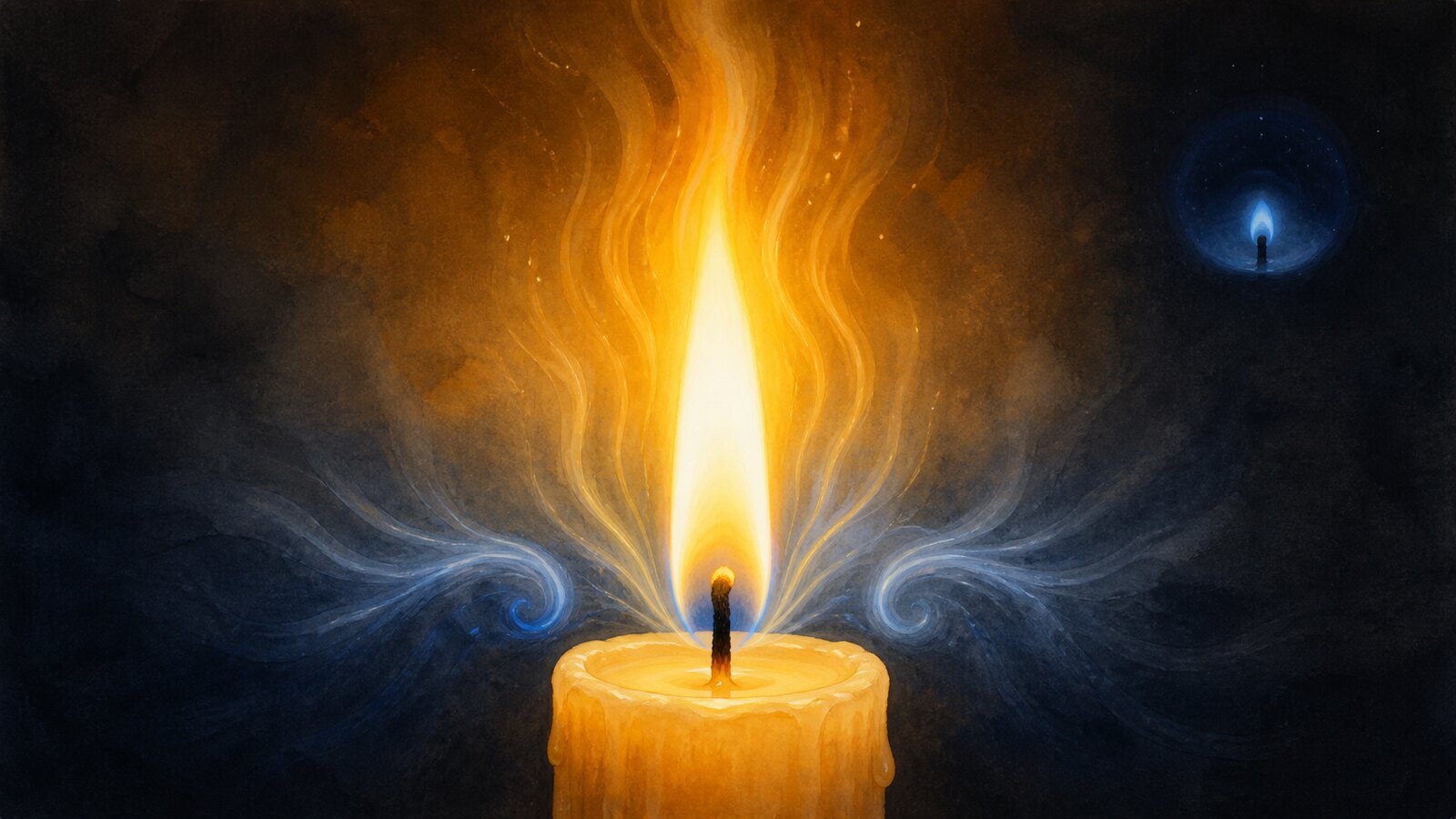
Glow sticks are often called sources of cold light because they do not work by heating a solid until it becomes incandescent. The chemistry directly creates excited molecular states, so the tube can shine without reaching the temperature of a bulb filament. Cold light does not mean that every joule becomes a photon or that no heat is produced at all. Some chemical energy disperses as molecular motion and heat. The distinction is that high bulk temperature is not the route used to make the visible emission.
Temperature changes the reaction rate and creates a trade-off between brightness and duration. In warmer liquid, molecules move and undergo effective collisions more frequently, so more dye molecules are excited per unit time and the first glow looks brighter. The reactants are consumed faster, however, and the stick fades sooner. Cooling slows the sequence, producing a dimmer but longer-lasting light. American Chemical Society comparison activities show this reversal over time: the initially bright warm stick can weaken before the cool one has exhausted its supply.
Putting a stick in a freezer therefore pauses part of its remaining reaction rather than recharging it. Cooling cannot reconstruct peroxide and oxalate ester that have already reacted. A chilled stick may brighten again as it warms because its leftover chemicals resume reacting more quickly, but the total available fuel continues to fall. A disposable stick also lacks the reversible electrochemical system and external circuit of a rechargeable battery. Once its starting reagents are substantially spent, no amount of shaking or light exposure restores them.
Chemiluminescence also differs from glow-in-the-dark phosphorescence. A phosphorescent sticker first absorbs photons from sunlight or a lamp and later releases part of that stored excitation slowly. A glow stick can sit in a dark drawer and still work because its energy source is the reaction initiated at the moment of mixing. Bioluminescence is a biological form of chemical light production controlled by molecules and enzymes in living systems; the commercial stick contains no glowing cells. Similar appearances can conceal different energy pathways.
The complete chain is thus mechanical separation followed by chemistry: bend the tube, break the inner ampoule, mix the solutions, form a high-energy intermediate, excite the dye, and release photons as the dye relaxes. Keeping the glass vial inside a flexible sealed shell solves both storage and activation, while formulation choices tune color, brightness, and lifetime. A glow stick shines without wires not because it uses no energy, but because it converts chemical energy directly into molecular excitation rather than first storing that energy as an electrical current.
EDITORIAL RESPONSIBILITY
FactosBrain Editorial Desk
The FactosBrain Editorial Desk researched and reviewed this article under our editorial policy. We assess error reports under our corrections policy.