Look a little closer
A fountain pen is not an open tank that simply lets gravity pour ink through the nib. It regulates an exchange: ink travels outward through narrow wettable passages while air returns toward the reservoir. When paper removes ink from the tip, capillary channels in the nib and feed replenish it. Air then replaces the lost volume in controlled increments. Surface tension and reservoir pressure interrupt that exchange before it becomes an unrestricted leak.
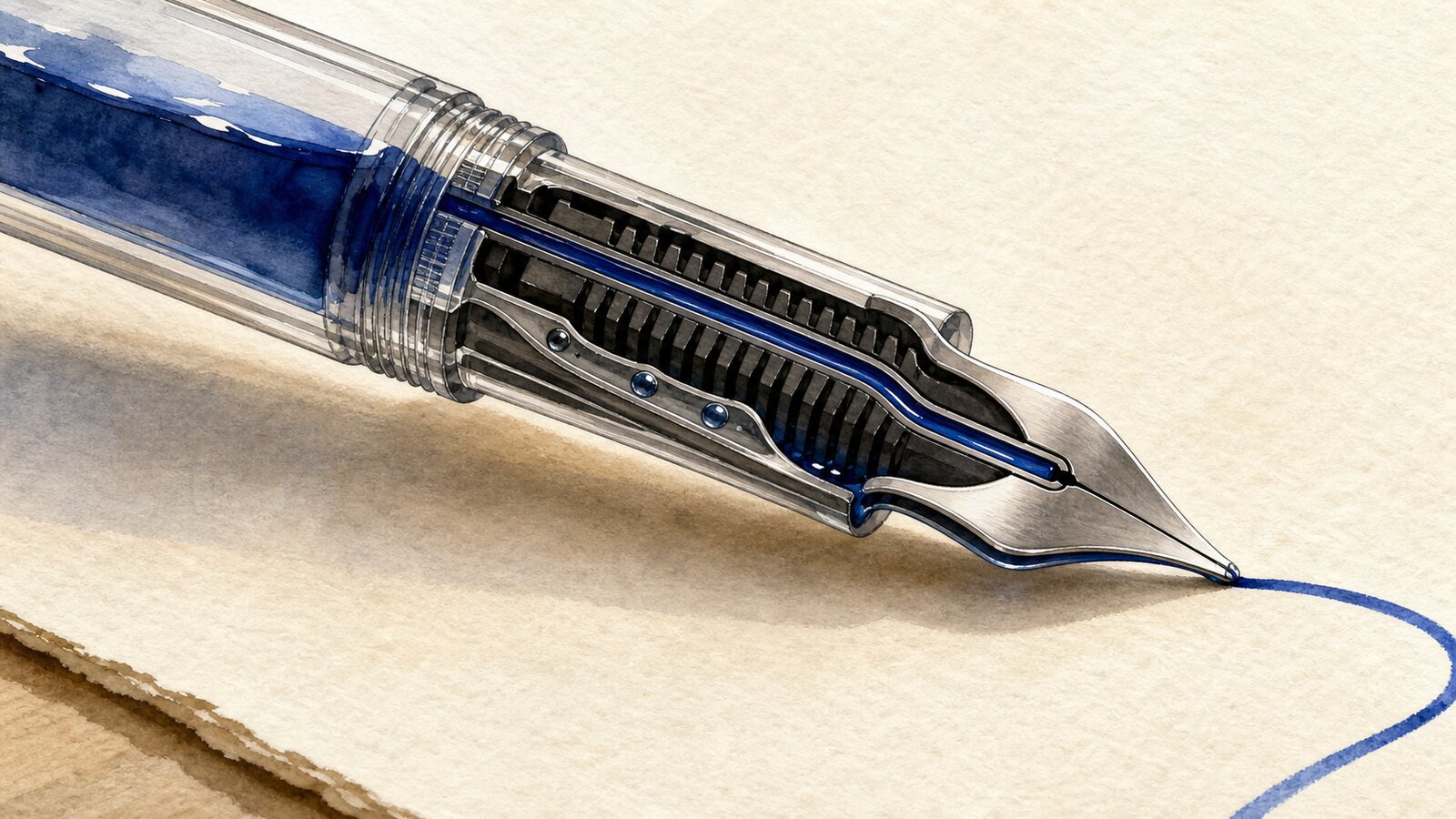
The dark ribbed component beneath the nib is the feed. It combines one or more narrow ink channels, a route by which outside air can reach the reservoir, and fin-like collector spaces that can hold excess liquid. The slit down the metal nib forms the final capillary passage to the tip. Cartridges, converters, piston fillers, and large eyedropper reservoirs store ink differently, but most fountain pens depend on this coordinated feed-and-nib interface once the ink reaches the section.
Capillary action arises when a liquid wets the walls of a narrow space. With a suitable water-based ink, the curved air-ink interface, or meniscus, creates a pressure difference that helps keep the passage filled. Smaller is not automatically better. A channel that is too broad may exert too little capillary control and permit flooding, while one that is extremely narrow or poorly wetted may impose enough viscous resistance to starve the nib. Surface tension, viscosity, channel geometry, and feed material must be matched.
Paper supplies the next pull in the chain. Its network of hydrophilic fibers and pores absorbs ink when the tip touches down. That removal draws on the thin film in the nib slit and on the continuous column in the feed. Writing pressure is not squeezing a pump. Pressure may spread the two tines slightly, changing line width and the flow demanded from the feed, but sustained delivery is governed by wetting, capillary pressure, reservoir pressure, and viscous loss through the small passages.
If ink left a sealed reservoir without replacement air, the gas remaining inside would expand and its pressure would fall. The growing pressure difference would soon oppose further outflow. A functioning feed therefore admits air as ink is consumed. When the pressure across an ink-air meniscus reaches the threshold needed to move it through the breathing route, a bubble enters the reservoir. Internal pressure recovers and the entry pauses. Continuous outward ink and intermittent inward bubbles form the pen's regulated breathing cycle.
The many fins around a feed are not propellers pushing ink forward. Their narrow collector gaps act as a temporary capillary buffer. Warming the pen in a hand can expand the air in its reservoir; climbing to lower atmospheric pressure can do the same relative to the surroundings. Either change may drive more ink toward the nib than writing consumes. Collector spaces capture some of that surplus as thin films instead of allowing a drop to escape, and can return it to ordinary circulation as conditions settle.
The balance has limits. A warm, shaken, nearly empty, or unusually full pen presents a different volume of compressible air and a different pressure history. Ink whose viscosity or surface tension is poorly suited to the feed can run too wet or too dry. Paper fibers and dried dye may interrupt either the ink path or the breathing path. Damaged grooves or a loose cartridge connection can bypass the intended restriction. Keeping a nib upright during a pressure change reduces the chance that expanding air will immediately push a continuous liquid column outward.
There is no single universal feed drawing. Some designs place air and ink routes beside each other; others use a dedicated breathing channel, radial collectors, and a small reserve directly under the nib. A broad or flexible nib can demand rapid replenishment without breaking the ink film, whereas a fine nib benefits from greater resistance to excess flow. Patents for modern feeds accordingly adjust capillary passages, air channels, tapering reserve spaces, and collector capacity to suppress pressure fluctuations while meeting different writing rates.
A smooth line is therefore a collaboration among several boundaries. Paper removes liquid at the tip. The nib slit and feed preserve a wetted capillary connection. The air route replaces the consumed volume in bubbles, the collector catches temporary excess, and the partial pressure drop in the reservoir helps restrain unlimited discharge. Open any route too far and the pen floods; obstruct it and the pen skips. What looks like ink obeying gravity is a small fluid machine timing how two fluids exchange places.
EDITORIAL RESPONSIBILITY
FactosBrain Editorial Desk
The FactosBrain Editorial Desk researched and reviewed this article under our editorial policy. We assess error reports under our corrections policy.