Friction-ridge impressions were used like seals long ago, but fingerprints became a large-scale identification system around the late nineteenth and early twentieth centuries. The decisive change joined observations of persistence with standardized capture and card classification, making an unknown record retrievable rather than merely distinctive.
Prints contain broad arches, loops and whorls as well as minutiae where ridges end or divide. Even identical twins differ in fine arrangement, and the underlying pattern generally persists through growth unless deep skin is seriously damaged. In real comparisons, however, a clear recording matters as much as the existence of those details.
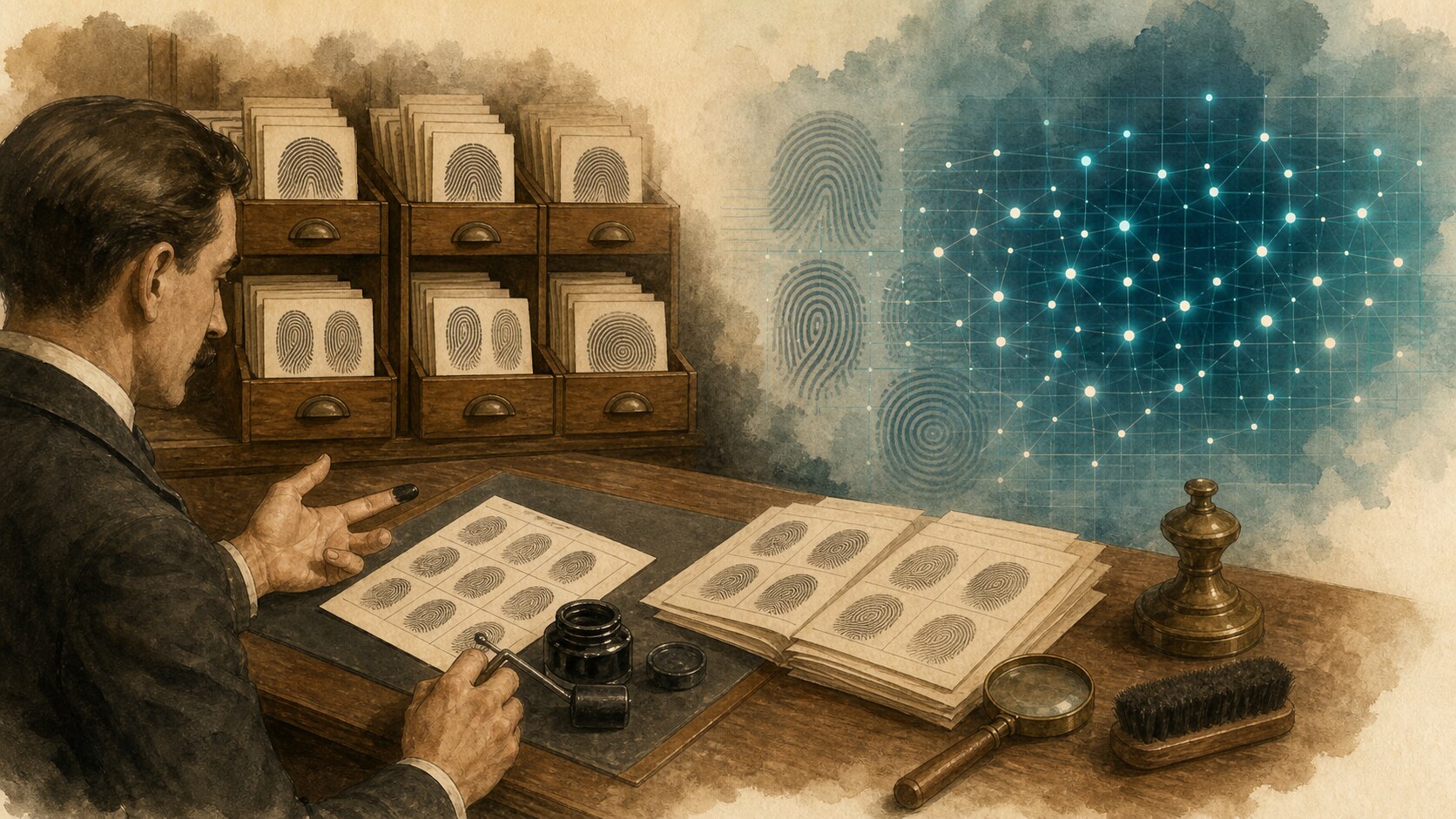
Researchers including Francis Galton studied ridge persistence and detail in the late 1800s. Edward Henry and colleagues then developed codes based on patterns across several fingers, sharply narrowing where a paper card should be filed. This classification made enormous physical collections searchable before computers.
US prisons and public agencies adopted fingerprint records in the early 1900s, and the FBI consolidated major collections into an Identification Division in 1924. A physical trait could distinguish people who changed names or shared the same one, helping fingerprints spread from criminal records into broader identity work.
Modern automated systems extract features from digital images and rank similar database candidates quickly. Latent marks can be partial, smeared or distorted by pressure and surface texture, so a software score is not a final proof of identity. NIST describes latent AFIS searches as returning candidate lists that examiners must compare manually.
Human comparison is not infallible either. Examiners assess the amount and clarity of surviving ridge information, spatial relationships and unexplained disagreement; insufficient material should produce an inconclusive result. NIST notes studies in which examiners occasionally reached different conclusions on the same evidence and emphasizes human factors such as training, documentation and independent review.
Fingerprint identification therefore works through a combination of persistent biology, standardized recording, searchable collections and controlled comparison—not through a slogan about uniqueness alone. Henry classification narrowed a paper-card search and modern algorithms narrow a digital candidate list, but neither is an automatic verdict that replaces quality assessment or corroborating evidence.
EDITORIAL RESPONSIBILITY
FactosBrain Editorial Desk
The FactosBrain Editorial Desk researched and reviewed this article under our editorial policy. We assess error reports under our corrections policy.