Look a little closer
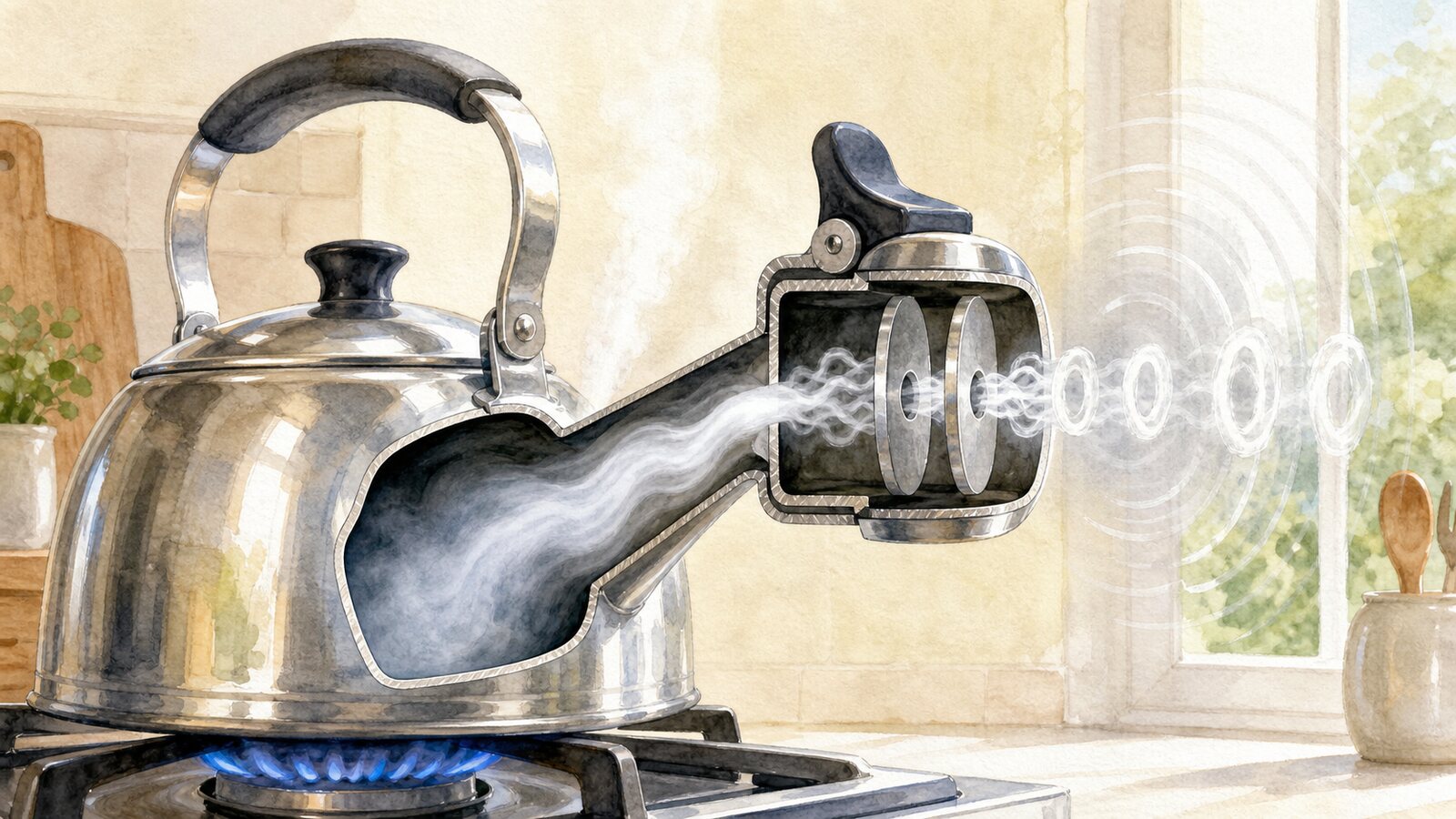
A whistling kettle does not sing because boiling water makes the metal vibrate like a bell. It whistles because a continuing stream of vapor is forced through two closely spaced holes in the cap, producing periodic pressure changes. In a classic two-plate whistle, a small cavity can resonate like a bottle at low flow, while a faster steam jet sheds vortices that couple to resonances in the spout and create the familiar piercing note.
It helps to separate this tone from the noises heard before a kettle boils. Vapor bubbles can form on a very hot base and then collapse in cooler surrounding water, producing rumbles, crackles, and knocks. A whistle requires a more organized gas flow. Once boiling supplies vapor continuously, a well-sealed lid directs much of it up the spout. The cap then restricts that path, accelerating the flow through a geometry capable of sustaining one dominant frequency rather than only a broad rushing sound.
A traditional whistle cap is not simply one thin plate with a hole. It has two perforated plates positioned close together, with a small cylindrical cavity between them and the openings aligned. Vapor rising through the relatively wide spout contracts into a narrow jet at the first orifice, crosses the cavity, and passes through the second. Acousticians call this arrangement a hole-tone system: a jet from one aperture interacts with a second aperture a short distance downstream.
At relatively low flow, the cavity behaves approximately as a Helmholtz resonator. The comparison is the tone made by blowing across a bottle. A plug of gas in the opening has inertia, while the compressible gas in the cavity acts like a spring. If the plug moves outward, pressure inside falls and pulls it back; if it moves inward, pressure rises and pushes it out. The flowing vapor feeds energy into that oscillation. Pressure variations near the system's natural frequency build into an audible tone that can remain almost constant in pitch over this low-flow region.
A faster jet produces a different dominant mechanism. The thin stream emerging from the first hole is unstable: tiny disturbances grow as it crosses the gap, so it does not remain a perfectly straight cylinder. Its interaction with the second plate and outlet creates pressure pulses, and organized vortex rings can peel away downstream. Those vortices do more than generate random turbulence. When their timing feeds back into the next disturbance of the jet, one rhythm becomes much stronger than the surrounding hiss.
The spout behind the cap also helps select the note. Cambridge researchers found that, in the higher-flow region, vortex shedding at the whistle exit couples to resonant modes of the upstream duct. Pressure waves travel through the spout and return to the jet. Frequencies that arrive with favorable timing reinforce the next oscillation; poorly timed ones fade. Hole diameter, cap geometry, spout length, and flow speed therefore affect pitch and loudness. A longer spout generally supports lower resonant frequencies, although the complete whistle cannot be predicted from length alone.
This two-region explanation came from measurements rather than a visual analogy. Ross Henrywood and Anurag Agarwal built simplified whistles, drove air through them at multiple flow rates, and recorded frequency and amplitude. A two-microphone method probed the acoustic field inside the spout, while water-flow visualization helped reveal the jet behavior. Their dimensionless analysis separated a low-Reynolds-number, nearly constant-frequency region from a higher-flow region in which frequency scaled with flow. A Helmholtz model accounted for the first; a coupled vortex-and-duct model accounted for the second.
Not every kettle produces two clean stages or uses this exact construction. A single-layer cap, a leaking lid, a different aperture, or an unusually shaped spout can add edge tones and broadband turbulence. The rumble of an electric kettle without a whistle need not arise from the same mechanism. Nor is the whistle a precision thermometer. It signals that enough vapor is flowing through a particular acoustic device; the actual boiling temperature can shift with atmospheric pressure and dissolved material.
The cap should never be lifted by hand for a closer look while the kettle is venting. A small outlet sends hot vapor out rapidly, and the metal around it can cause burns even after the heat is turned off. The useful warning tone joins several pieces of physics in sequence: boiling supplies vapor, the two holes turn a steady flow into repeated pressure disturbances, vortices organize at higher speed, and the cavity or spout strengthens selected frequencies. A humble kettle whistles because its lid contains a compact wind instrument powered by steam.
EDITORIAL RESPONSIBILITY
FactosBrain Editorial Desk
The FactosBrain Editorial Desk researched and reviewed this article under our editorial policy. We assess error reports under our corrections policy.