Look a little closer
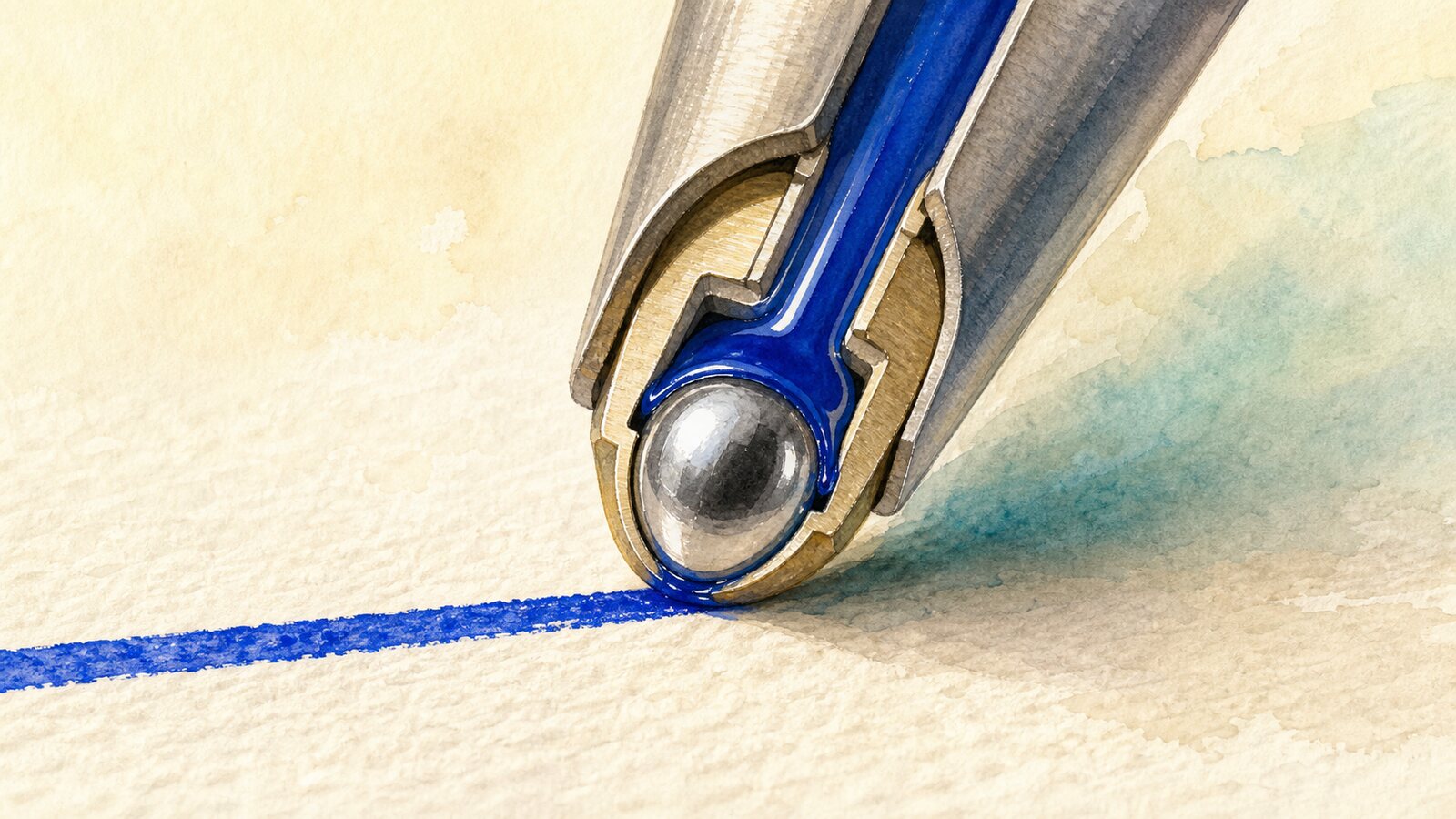
The tiny ball in a ballpoint pen is a rotating transporter between the ink reservoir and the paper. Friction with the page makes the ball roll; its inner surface picks up viscous ink from a narrow feed, and its exposed surface presses a thin film onto paper. The close-fitting socket retains the ball and meters the flow, so the reservoir is not simply an open hole that can empty at once.
Under magnification, a ballpoint tip is not a sharp metal needle. It is a small sphere captured in a funnel-shaped metal socket, with most of the sphere enclosed and only a portion projecting far enough to touch the page. A fine passage behind it connects the ball to the ink tube. Manufacturing tolerances must hold the sphere securely while leaving just enough clearance for it to rotate freely in more than one direction.
Writing begins when rough paper fibers exert friction on the exposed ball. A surface that was facing the reservoir is already wet with ink; rotation carries it down to the contact zone. There, ink adheres to the paper and some enters spaces between fibers. The same patch of metal then rolls back into the socket to be recoated. Repeating this cycle lays down a continuous trail without pouring a free stream of liquid through the tip.
The ball is both applicator and moving seal. The minute gap between sphere and socket lets ink wet the rotating surface but does not leave room for a large drop to pass. When the ball stops, active transport to the page largely stops as well, while viscosity and surface tension resist flow through the narrow clearance. A sound ballpoint can therefore remain tip-down without promptly draining its entire tube, though the mechanism is not an absolute leak-proof valve.
Ink formulation is as important as the metal hardware. Traditional oil-based ballpoint ink is much more viscous than fountain-pen ink and is designed to set relatively quickly. Ink that is too fluid can flood the socket, bleed into paper, and leak; ink that is too thick may fail to wet the ball and feed channel, producing skips. Dyes or pigments, solvents, resins, and additives are balanced so the mixture coats the ball, transfers readily to paper, and remains stable in storage.
Gravity helps move ink toward the tip in many ordinary pens, but gravity is not the whole explanation. Wetting in the narrow feed, viscosity, air entry at the back of the refill, and pressure balance all matter. That is why a conventional ballpoint may stop after writing upside down for a while. A pressurized space pen uses a different supply system: gas pressure pushes specially formulated ink toward a tungsten-carbide ball, allowing the pen to work in orientations and environments where gravity feed is unreliable.
Pressing harder does not pump ink out like squeezing a syringe. Moderate writing pressure keeps the ball in reliable contact with the paper and provides the friction needed for rotation. Too little contact can allow slipping or skipping over surface texture; excessive pressure can emboss the sheet and increase wear at the ball and socket. Smoothness therefore emerges from the combined geometry of the ball, socket clearance, ink rheology, and paper, not from hand force alone.
The familiar attempt to revive a pen by scribbling also follows from this design. Ink exposed at the tip can dry and stick the ball, dust can lodge in the socket, or an air bubble can interrupt the feed. Short strokes on slightly rough paper may rotate the ball, break a thin dried film, and bring fresh ink back around its surface. Scribbling cannot repair a dented socket, a badly contaminated tip, or ink that has hardened throughout the channel.
John Loud patented a rolling-ball writing principle in the United States in 1888, but that device did not become the modern mass-market pen. In the 1930s László Bíró and collaborators paired a ball-and-socket tip with thick, quick-drying ink, and improved manufacturing made the idea practical in the 1940s. The decisive achievement was not merely placing a bead at the end of a tube; it was matching ink, clearance, materials, and precision. Every ordinary line is the output of that microscopic rolling valve, measured out one turn at a time.
EDITORIAL RESPONSIBILITY
FactosBrain Editorial Desk
The FactosBrain Editorial Desk researched and reviewed this article under our editorial policy. We assess error reports under our corrections policy.