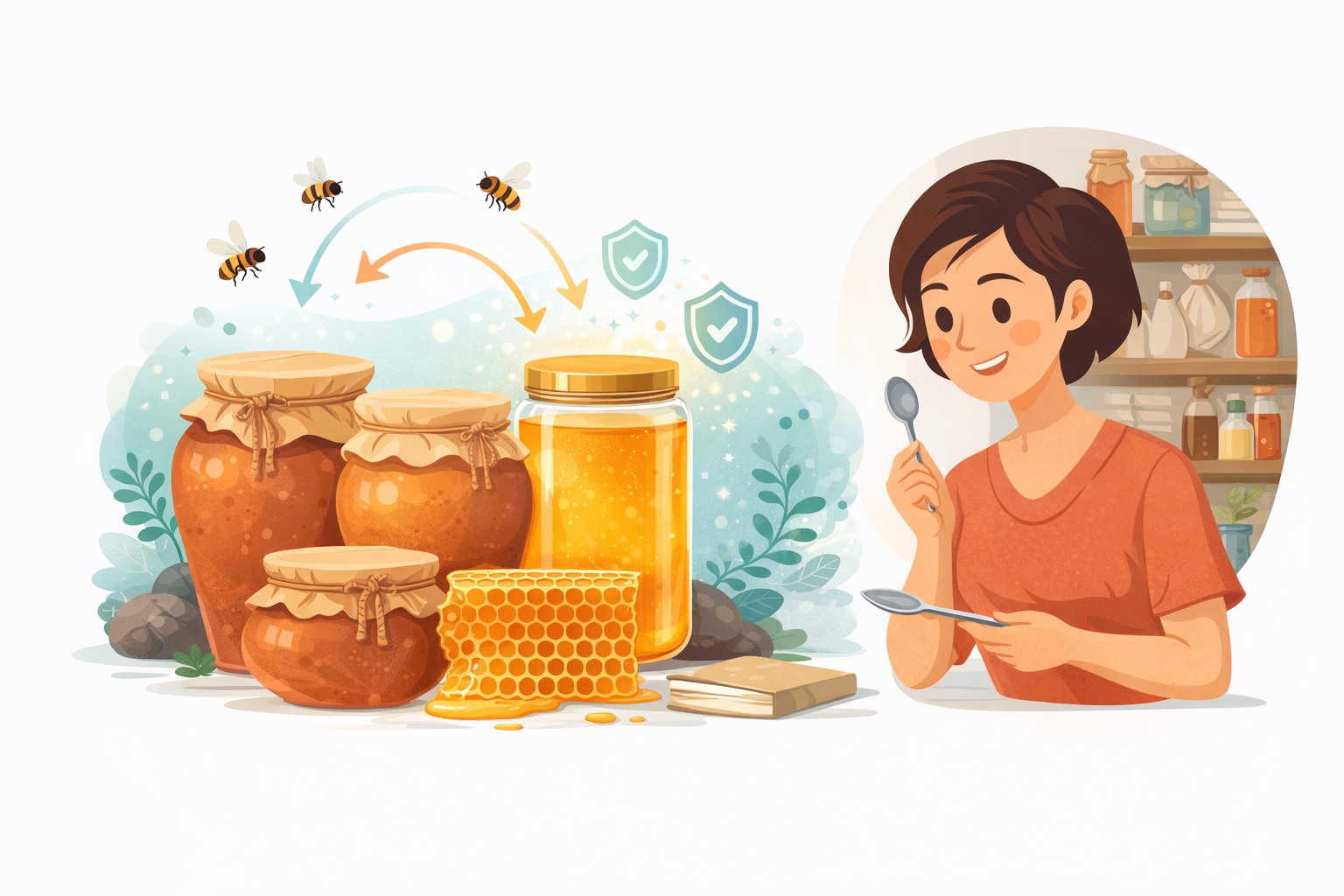
Honey can remain edible for an exceptionally long time because it combines several conditions that most spoilage microbes cannot tolerate. Mature honey contains a great deal of sugar but relatively little water, and much of that water is bound up in the concentrated sugar solution. Bacteria and molds therefore struggle to obtain the free water they need to grow.
Bees create this hostile environment from watery flower nectar. They repeatedly process the nectar and fan air across the comb, removing moisture until it becomes concentrated enough for storage. The result has low water activity, a measure of how much water is actually available for microorganisms rather than simply how much water a food contains.
Acidity adds another layer of protection. Honey commonly has a pH in the acidic range, and enzymes introduced by bees help produce compounds including gluconic acid. When honey is diluted, the enzyme glucose oxidase can also contribute small amounts of hydrogen peroxide. No single feature explains the shelf life; low water activity, acidity and bee-derived chemistry work together.
That does not make every jar indestructible. Honey readily absorbs moisture from humid air, so a poorly sealed container can become diluted enough for moisture-tolerant yeasts to ferment it. Food crumbs, dirty utensils or added water can also change the conditions. The long shelf life belongs to mature, uncontaminated honey stored in a closed container.
Crystallization is often mistaken for spoilage. Glucose can separate from the liquid and form pale grains, making honey thick or solid, while the food remains usable. Gentle warming can dissolve the crystals again. An unusual odor, foam or clear signs of fermentation are different and should not be dismissed as ordinary crystallization.
Stories about ancient honey survive because the underlying chemistry is genuinely remarkable, but “never spoils” is better understood as shorthand than a guarantee. Honey lasts not because time stops inside the jar, but because bees manufacture a concentrated, acidic food in which the organisms that normally mark time through decay have very little opportunity to grow.
EDITORIAL RESPONSIBILITY
FactosBrain Editorial Desk
The FactosBrain Editorial Desk researched and reviewed this article under our editorial policy. We assess error reports under our corrections policy.