Look a little closer
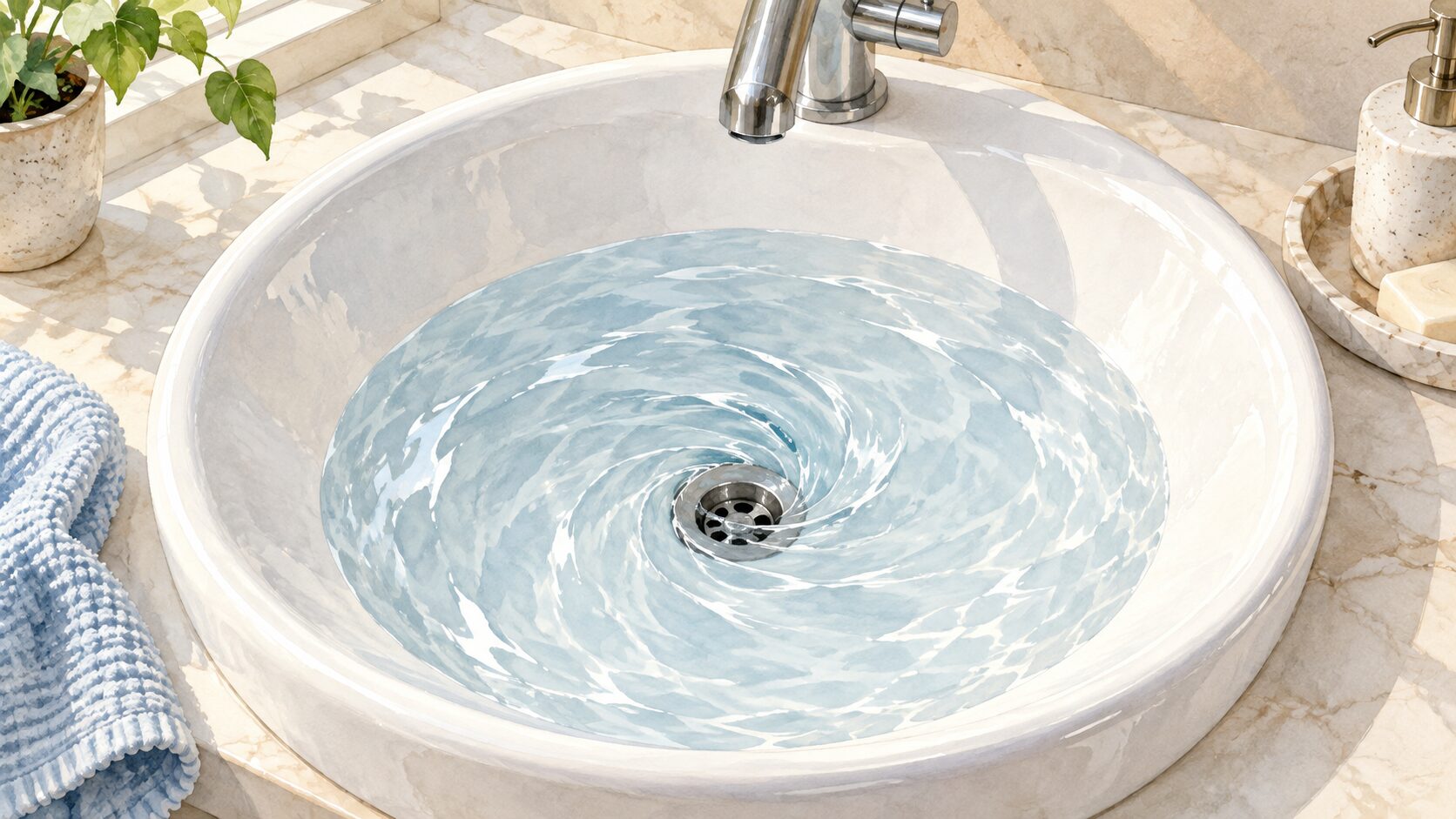
Water in a household sink does not have to reverse its swirling direction when you cross into the Southern Hemisphere. How the basin was filled, motion already present in the water, and the shape of the basin and drain normally matter more than the small influence of Earth's rotation. Clockwise and counterclockwise drainage can occur in either hemisphere. Watching one whirlpool in a hotel bathroom therefore cannot reliably tell you which half of the world you are visiting, even if its direction happens to match the familiar story.
The story sounds plausible because a real physical effect changes direction between hemispheres. Viewed from the rotating Earth, horizontal motion tends to be deflected to the right of its direction of travel in the north and to the left in the south. This is the Coriolis effect. It is part of describing motion from a rotating frame of reference, rather than a special twisting mechanism installed in sinks. Establishing that the effect exists is one step; establishing that it dominates a particular visible swirl requires comparing it with the other influences acting on the water.
Weather supplies a familiar example where the comparison is different. Air moving around a large low-pressure system travels over substantial distances and times, making Earth's rotation important to the circulation. As motion toward lower pressure is deflected, large lows generally circulate counterclockwise in the Northern Hemisphere and clockwise in the Southern Hemisphere. A washbasin, however, is not a weather system reproduced at a smaller size. Changing the length, duration, and conditions of a flow changes the relative importance of the effects involved. A rule that works well for a large atmospheric circulation need not predict a domestic drain.
Water also has a history before the plug is removed. A stream from the tap may have run along one side of the bowl, or a hand and the movement of the plug may have introduced a little rotation. A surface that looks calm does not prove that every small current has disappeared. As water converges toward the outlet, those initial conditions can influence the eventual swirl. The observer may have done nothing deliberately to stir the basin, yet that is not equivalent to removing all sources of motion other than Earth's rotation.
The container contributes its own conditions. Asymmetry in the bowl, the position and geometry of the outlet, and the incoming stream can favor a particular circulation. Repeatedly seeing the same direction in the same sink may therefore reflect a repeated filling procedure and unchanged hardware. The Library of Congress's everyday-science explanation emphasizes the introduction of water and the geometry of the drain for this reason. Repetition alone does not identify the cause of a result. It is also necessary to ask which influences were kept the same every time the observation was repeated.
The opposite absolute claim, that Earth's rotation can never be detected in a small tank, would go too far. A weak influence can become measurable when competing disturbances are made sufficiently small. Ascher Shapiro's 1962 work on the bathtub vortex and subsequent investigations addressed carefully controlled conditions. A 1965 paper on the Southern Hemisphere describes earlier northern experiments in which researchers suppressed other influences and attributed the resulting counterclockwise rotation to Earth. The key distinction is not whether the apparatus can loosely be called a bathtub, but how thoroughly unwanted currents and other sources of rotation have been controlled.
This distinction helps interpret a simple observation at home. If gently stirring water changes the direction of a draining vortex, it shows that a small everyday disturbance can control that particular result. It does not prove that the Coriolis effect is nonexistent. Conversely, detecting Earth's influence in a carefully prepared experiment does not establish that every ordinary sink must follow the same direction. These are different questions with different requirements for evidence. A conclusion should remain tied to the preparation and conditions that made the observation possible, rather than being extended automatically to all similar-looking containers.
The same reasoning applies to demonstrations that move a bowl a short distance near the equator, pour in water, and immediately display a reversed swirl. If the pouring direction or residual motion changed along with the position, the observation cannot isolate hemisphere as the cause. A useful explanation of a drain therefore asks more than which way the water turned. It asks how the flow began, what motion remained, and whether Earth's rotational influence was large enough relative to the others to determine the outcome. Those questions separate an ordinary bathroom vortex from both a controlled experiment and a planetary weather pattern.
EDITORIAL RESPONSIBILITY
FactosBrain Editorial Desk
The FactosBrain Editorial Desk researched and reviewed this article under our editorial policy. We assess error reports under our corrections policy.