Look a little closer
Not every shark must swim continuously in order to breathe. Some can remain on the bottom and pump water across their gills with muscles around the mouth and throat, some depend heavily on the flow created by forward motion, and others can shift between the two methods. The familiar claim that a shark dies as soon as it stops takes a real constraint of certain species and turns it into a rule for the whole group.
Like other fishes, sharks extract oxygen dissolved in water rather than splitting oxygen from the water molecule itself. Water passes over thin, blood-rich surfaces in the gills, where oxygen diffuses into the circulation and carbon dioxide diffuses out. The essential requirement is therefore a continuing supply of fresh water across those exchange surfaces. The shark's whole body does not necessarily have to move; what differs among species is how they produce the flow.
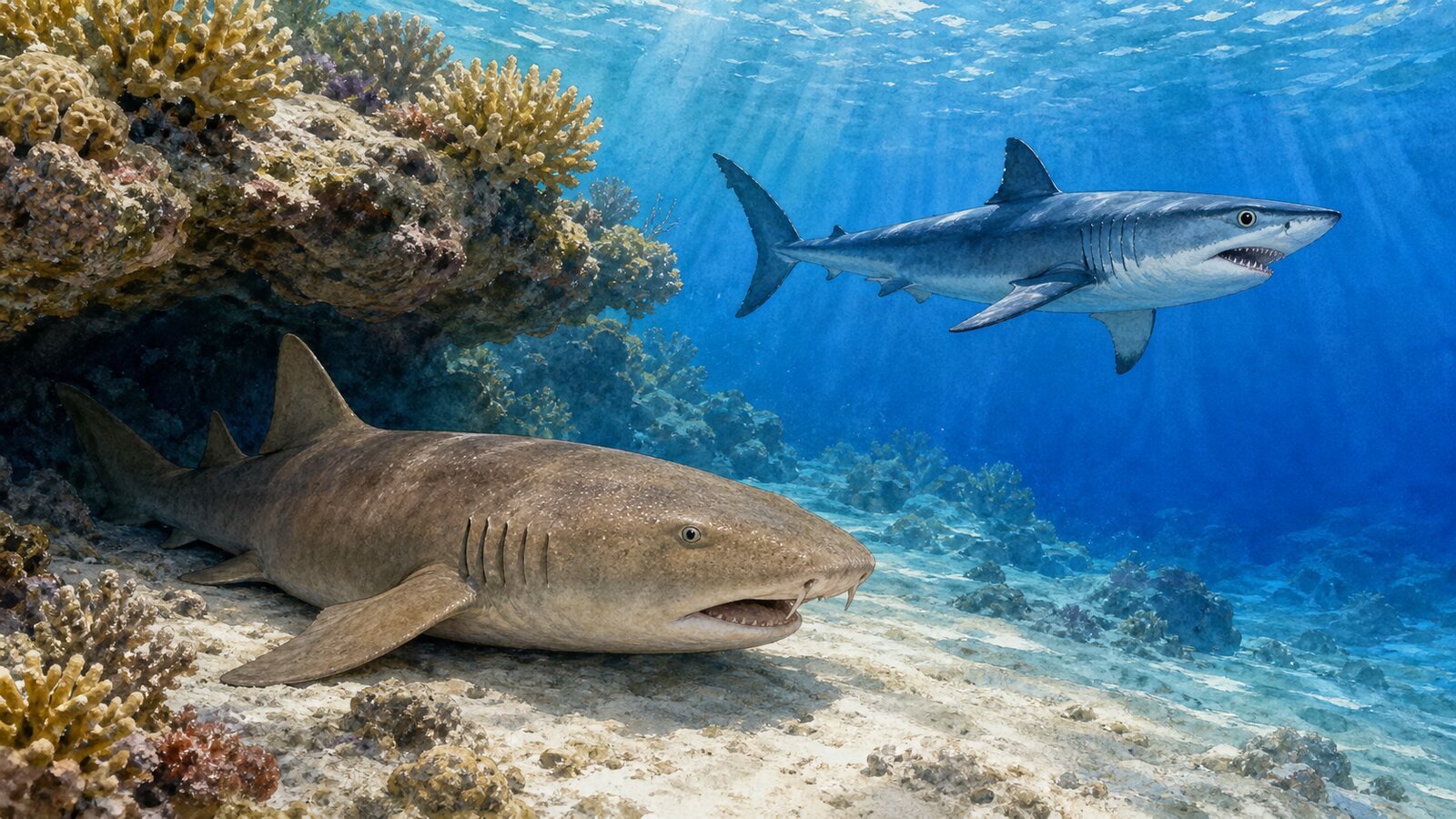
One solution is buccal pumping. By changing the volume of the mouth and pharyngeal cavity, a shark creates pressure differences that draw water in and push it out through the gill slits. Nurse sharks, wobbegongs, and angel sharks are familiar bottom-dwelling examples. They can lie on sand or reef while ventilating. In many benthic sharks, spiracles—openings just behind the eyes—also help admit relatively clean water when the mouth is close to sediment or occupied by prey, although spiracles do not perform every part of the pump by themselves.
The second solution is ram ventilation. A shark swimming with its mouth open meets a relative current, and that forward flow carries water through the gill chamber with less active pumping. It suits streamlined animals that cruise through open water. A subset are described as obligate ram ventilators because adequate ventilation depends on sustained movement. Great white sharks and some of their fast-swimming relatives are commonly placed in this category, but the precise abilities of difficult-to-observe species should not be treated as permanently settled.
These modes are not always two sealed boxes. Many sharks actively pump at rest or at low speed and increasingly exploit ram flow as they accelerate. There are also observations that complicate old labels. In a 2020 study of shark activity rhythms, one spiny dogfish—then treated as a ram ventilator—was recorded resting and using buccal movements. A single captive individual cannot establish what every member of its species can do in the wild, but it shows why behavior, conditions, and direct observation matter more than a slogan.
Habitat and body design help shape the strategy. An ambush predator on the seafloor needs to move water without exposing itself or drawing large quantities of sand into its mouth. A pelagic shark that already travels long distances can use the oncoming stream and reduce the muscular work of ventilation. Temperature, dissolved oxygen, body size, and activity change the amount of flow required. Even an animal capable of both methods may rely on them in different proportions while resting, feeding, or swimming rapidly.
Breathing is also often confused with buoyancy. Sharks generally lack the gas-filled swim bladder used by many bony fishes. An oil-rich liver reduces their density, while fins and a moving body can generate lift, so forward motion helps some species hold depth. That does not make sinking and suffocating the same event. A bottom-adapted shark can settle safely and continue pumping water, while a pelagic species may gain both respiratory flow and hydrodynamic support from swimming for separate mechanical reasons.
Continuous movement does not by itself prove that a shark never sleeps. Rest in fishes is identified through changes in activity and responsiveness, not simply by closed eyelids and complete immobility. Some sharks visibly rest on the bottom. How species that must keep moving coordinate locomotion with sleep-like states remains an active research question, and their brains and behavior need not follow the human pattern. Ventilation mode alone cannot answer whether, when, or how a shark rests.
A motionless shark is therefore not automatically a shark in immediate danger, and it would be equally wrong to assume that every species can be held still without harm. All sharks face the same physical task—moving oxygenated water over gill tissue—but evolution has supplied different pumps. The resting nurse shark and the cruising open-ocean hunter are not exceptions to one universal rule; they are contrasting solutions. To know whether a particular shark can stop, you need its species, environment, and current behavior, not a line borrowed from a film.
EDITORIAL RESPONSIBILITY
FactosBrain Editorial Desk
The FactosBrain Editorial Desk researched and reviewed this article under our editorial policy. We assess error reports under our corrections policy.