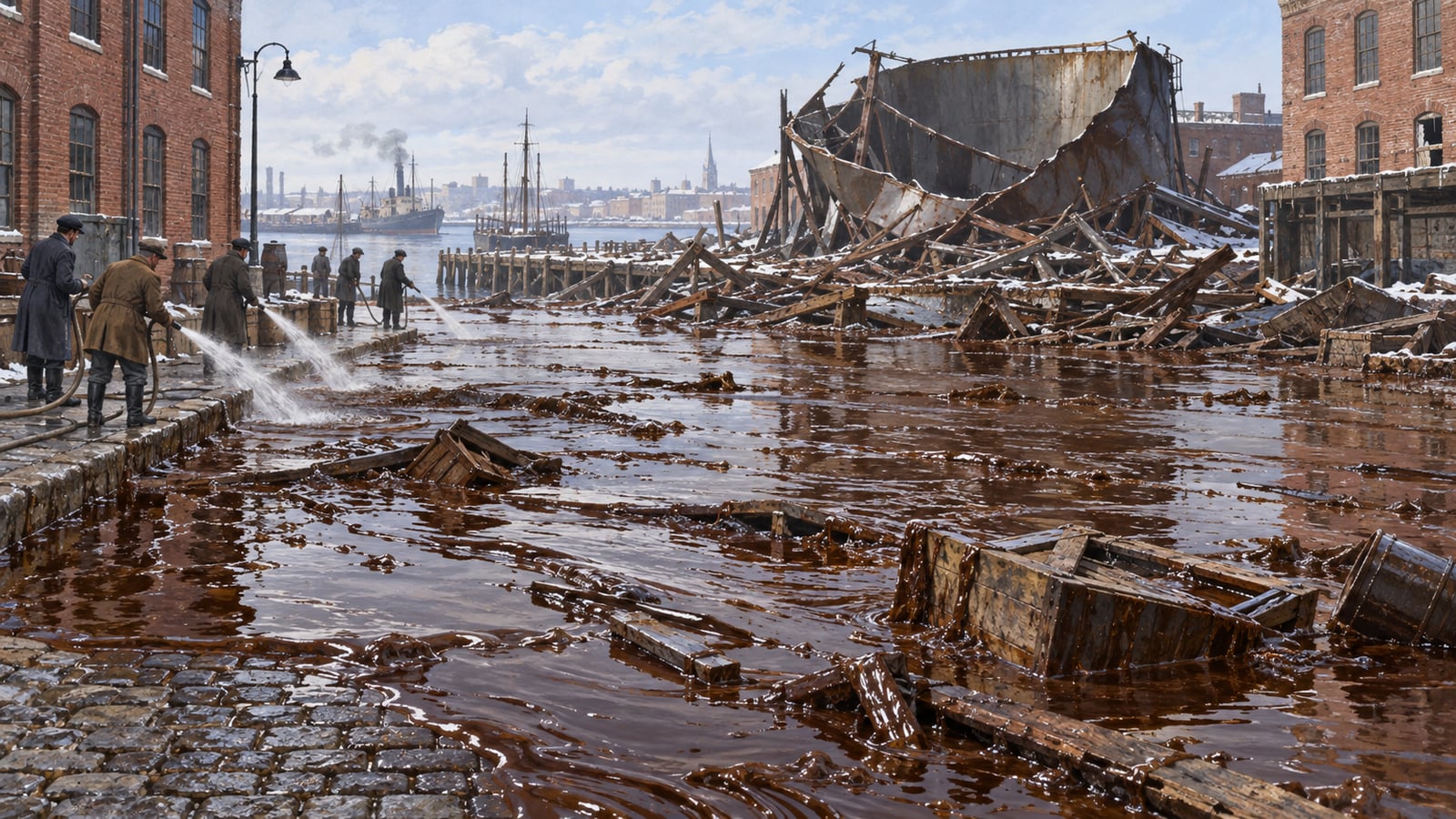
The flood that entered Boston's streets on January 15, 1919, was not water. It was molasses: a thick, dark liquid released from an enormous storage tank. Buildings collapsed and elevated railway girders bent. The familiar image of syrup creeping out of a bottle offered little preparation for that much liquid arriving at once.
The tank held about 2.3 million US gallons, or 8.7 million liters. Standing roughly 50 feet high beside the waterfront, it stored shipments before they went to distilleries. Molasses was more than a food ingredient. It could be fermented into alcohol, including industrial alcohol used in making munitions. The tank belonged to a system that handled the material in immense quantities.
Residents already knew it leaked. Molasses seeped through seams, and children reportedly collected it. When complaints followed, the company painted the tank brown to disguise the stains. Built in 1915, it was not an ancient structure nearing the end of a long working life. Later engineering assessments found its walls too thin for the heavy contents.
When the tank failed, the escaping mass struck the surrounding neighborhood. The next day's Boston Post described twisted and broken railway girders and a wooden dwelling displaced and wrecked. Sweetness offered no protection from that force. A vast quantity stored high above street level had suddenly been released into the streets below.
After the initial impact came another difficulty: moving through what remained. Rescuers had to struggle through molasses, and the liquid coated wrecked vehicles and building debris. Police, military personnel and the Red Cross joined the response. Twenty-one people died and about 150 were injured. Those killed included workers, children and a firefighter. The unusual substance had produced an ordinary disaster's terrible human losses.
Cleanup required more than waiting for floodwater to drain. Workers washed the molasses away with water pumped from the harbor. People carried the sticky residue into surrounding streets, public transport and homes. Clearing the material from the city took far longer than releasing it from the tank.
The company initially blamed an anarchist bombing. Victims argued that the structure itself had been unsafe. The investigation examined its leaks, construction and the handling of warnings. In 1925, a court-appointed auditor assigned responsibility to the company's negligence and structural failure. The noise of a sudden rupture did not establish that a bomb had caused it.
Much later, physicists returned to the event, investigating how a viscous liquid could spread so rapidly and how temperature affected its behavior. Understanding the disaster required studying both the failed container and what escaped from it. The historical photographs preserve crumpled metal and wrecked buildings: the remains of a neighborhood struck by material that, only moments earlier, had been stored as industrial stock.
EDITORIAL RESPONSIBILITY
FactosBrain Editorial Desk
The FactosBrain Editorial Desk researched and reviewed this article under our editorial policy. We assess error reports under our corrections policy.