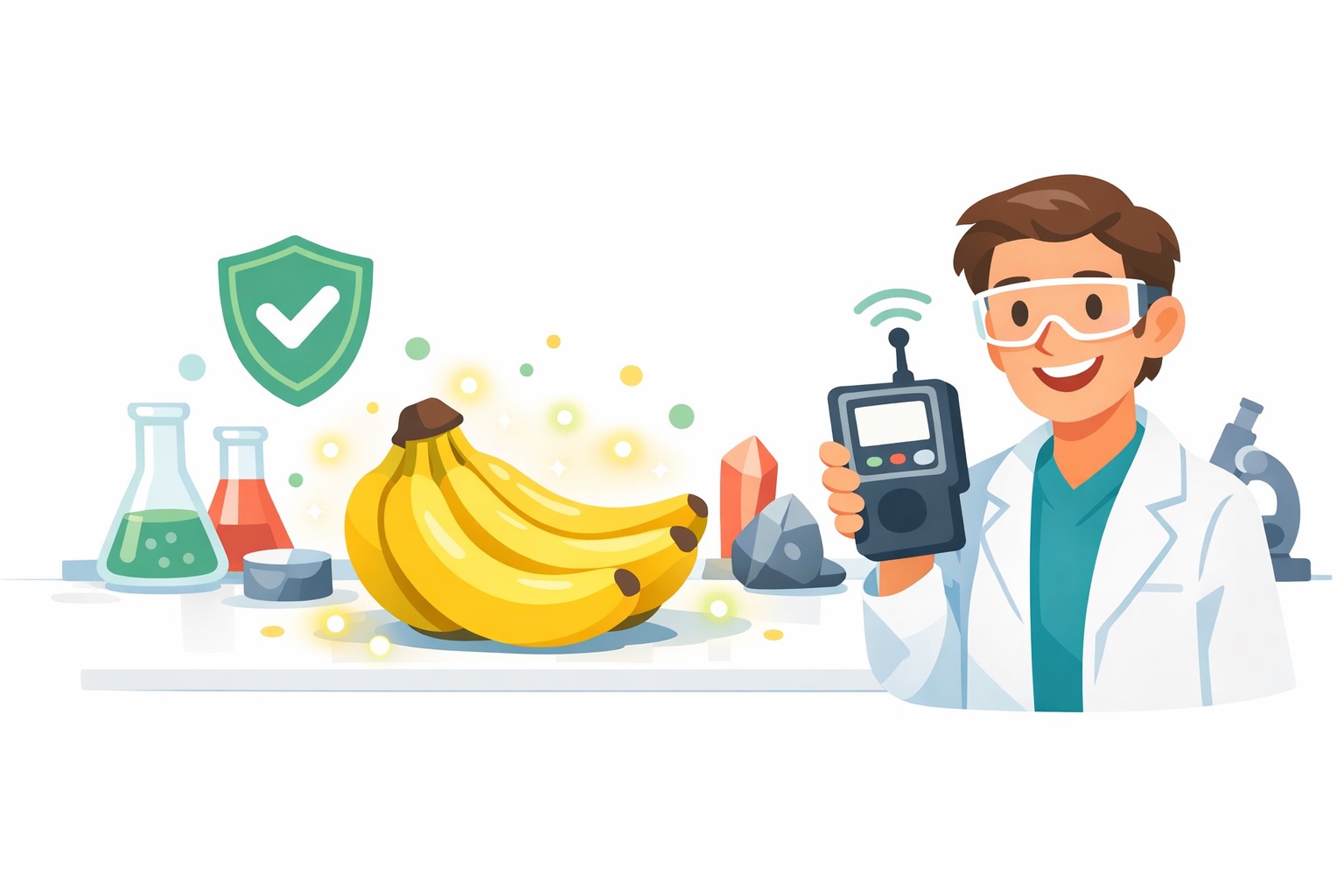
A banana is very slightly radioactive because it contains potassium, an essential element for both plants and people. Most natural potassium is stable, but a tiny fraction is the radioactive isotope potassium-40. Since banana plants take up potassium from soil, that same natural isotope mixture becomes part of the fruit.
An isotope is a version of an element with the same number of protons but a different number of neutrons. Potassium-40 is unstable and occasionally decays, releasing radiation. The activity in one banana is small, and eating it adds only a minute radiation dose compared with the natural background radiation people continually receive from the ground, air and cosmic rays.
The “banana equivalent dose” was invented as an informal way to make very small radiation quantities easier to picture. A commonly cited estimate is around a tenth of a microsievert per banana, though the exact value depends on the fruit's potassium content and on how dose is calculated. It is a comparison tool, not an official unit of radiation protection.
The comparison also has an important limitation. The body regulates its total potassium closely because the element is necessary for nerves, muscles and fluid balance. When dietary potassium rises, healthy regulatory systems generally adjust how much is retained and excreted. Eating another banana therefore does not simply stack potassium-40 in the body forever.
Many ordinary foods contain naturally occurring radionuclides. Potatoes, beans, nuts and other potassium-rich foods contain potassium-40, while some foods also contain small amounts of carbon-14 or radionuclides from natural uranium and thorium decay chains. Radioactivity is a measurable property of nature, not by itself evidence that a food is dangerous.
The useful lesson is not that bananas are a radiation hazard. It is that sensitive instruments can detect radioactive atoms in familiar matter and that the word “radioactive” says nothing about dose on its own. Risk depends on the type, amount and route of exposure; in a banana, the amount involved is extraordinarily small.
EDITORIAL RESPONSIBILITY
FactosBrain Editorial Desk
The FactosBrain Editorial Desk researched and reviewed this article under our editorial policy. We assess error reports under our corrections policy.