Look a little closer
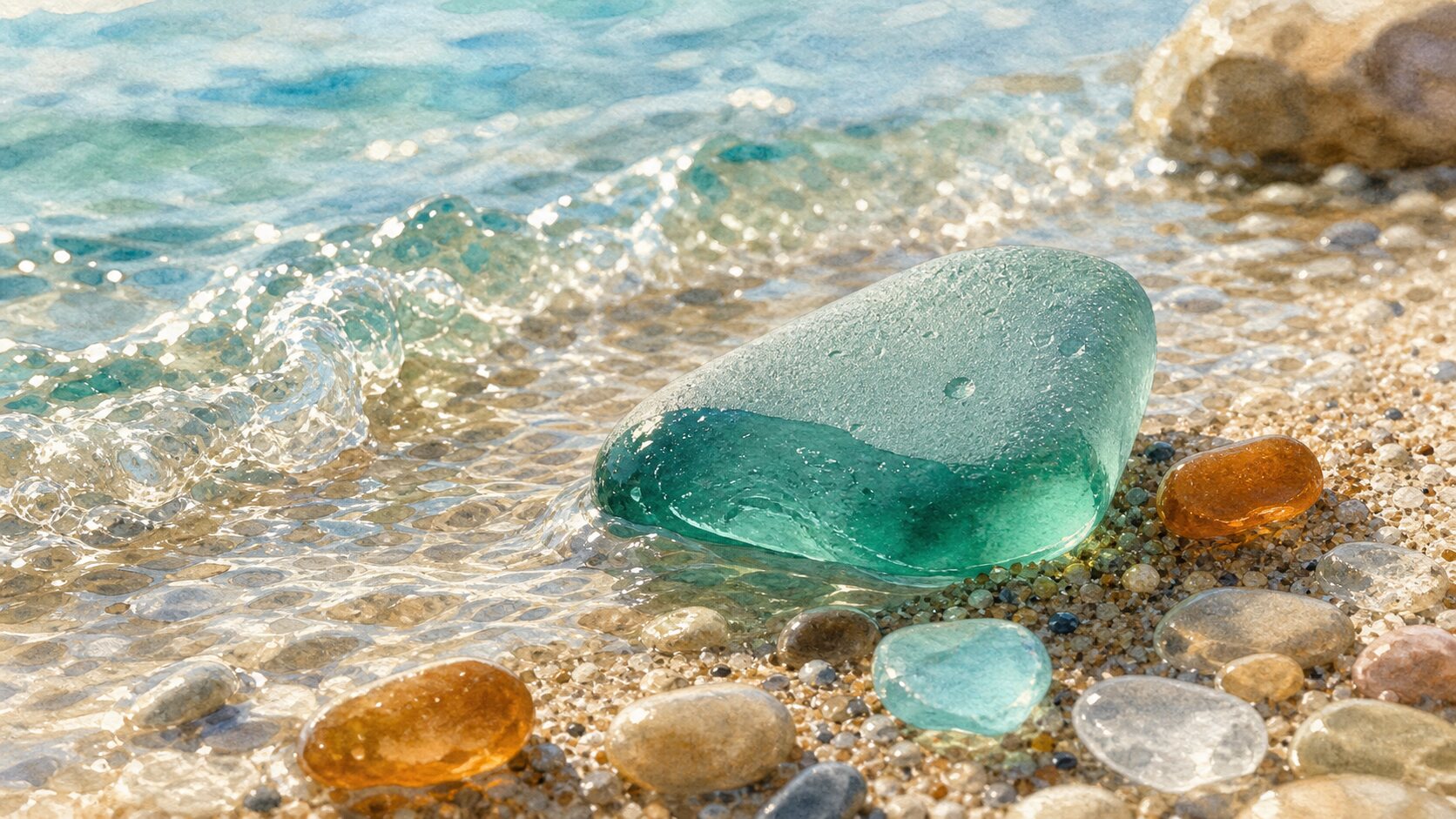
Sea glass becomes rounded and frosted through a combination of physical abrasion and chemical weathering. Waves repeatedly drive broken manufactured glass against sand, gravel, and rock, chipping away sharp projections. At the same time, water alters the glass surface. Scratches, pits, and chemically changed layers turn a once-smooth boundary into one that scatters light in many directions. The outcome varies with the beach and with the glass itself.
Most sea glass did not begin as a special gem. It is commonly a fragment of a bottle, tableware, window, or other manufactured object. After entering coastal water, a piece moves up and down the shore, may be buried in sediment, and can be exposed again by storms. Each collision concentrates stress at thin edges and projecting corners. Repeated impacts from changing directions remove small chips until the outline becomes safer and more rounded.
Rounding and frosting are related but not identical. Impacts can leave crescent-shaped gouges and curved, shell-like fractures, while moving sand produces grooves and fine scratches. A fragment that feels smooth to a finger may still have a landscape of microscopic relief. Wave energy, sediment size, travel distance, and time spent buried all differ. Consequently, pieces from the same beach can range from angular and glossy to rounded and matte.
Water is more than the conveyor belt. Common soda-lime glass consists of a silica network modified by elements including sodium and calcium. At a wet surface, hydrogen-bearing species from water can exchange with mobile alkali ions in the glass. As elements such as sodium are leached, a relatively silica-rich hydrated region may remain. Depending on pH, dissolved salts, temperature, and original composition, the surface can develop fine cracks, solution pits, and precipitated material.
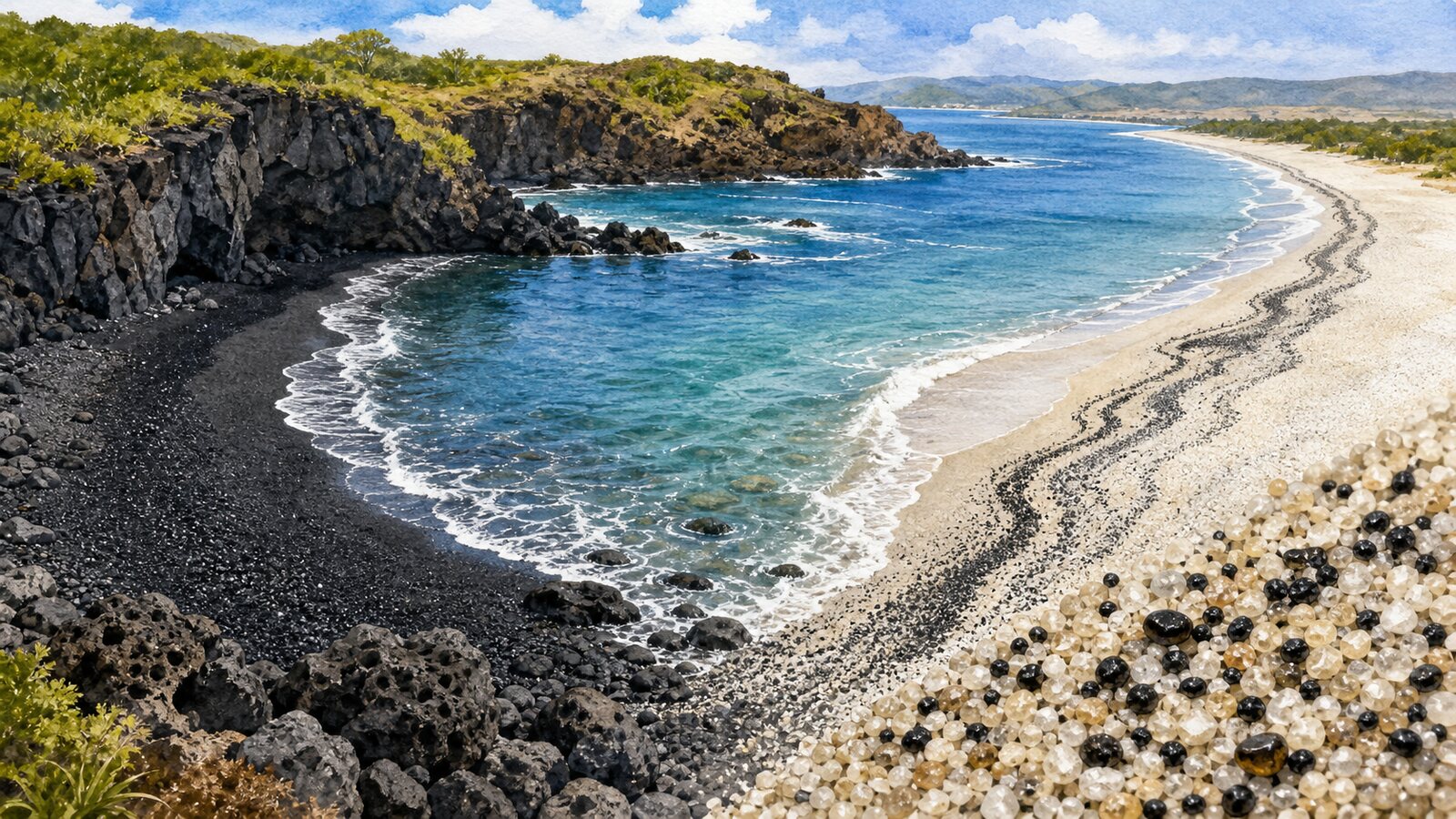
A study of sea glass from Port Allen on Kauai documented both histories on real grains. Researchers used scanning electron microscopy and surface chemical analyses to identify mechanical features such as conchoidal fractures, crescentic gouges, and straight grooves. They also found C-shaped cracks, solution pits, halite, and silica precipitation associated with chemical weathering. One Hawaiian beach cannot represent every coast, but the observations show why choosing either 'sand' or 'seawater' as the sole cause is inadequate.
The frosted look is largely an optical consequence of the rough boundary rather than the glass interior turning milky. A polished surface transmits and reflects light in relatively orderly directions. Microscopic hollows and tilted facets refract and reflect rays along many paths, creating a pale matte appearance. Wet sea glass often looks darker, more saturated, and clearer because water fills the relief and reduces the sharp refractive-index contrast between glass and air. When it dries, air returns to the pits and the diffuse haze reappears.
Appearance is not a reliable stopwatch. A high-energy shingle beach can abrade a moving fragment quickly, while a piece buried in mud in a sheltered bay may change slowly. A new break can put a shiny face on otherwise weathered glass. Composition, thickness, and flaws affect durability as well. Roundness and frosting record transport conditions as well as elapsed time, so a collector cannot calculate an exact number of years from surface texture alone.
Green, brown, aqua, and other colors usually come from the original glass formulation and thickness, not from the sea inventing a new hue. Colors used in common beverage containers remain common on many shores, whereas glass from particular historical products may be less frequent. Color by itself cannot securely identify a date or former object. Mechanical tumblers can also round fragments and create matte surfaces, leaving no single visual feature that always proves a piece weathered naturally in the sea.
Sea glass is best understood as a surface history rather than glass simply polished by the ocean. Collision removes corners at the scale of the whole fragment while scratching and pitting roughen it at microscopic scales; water-driven ion exchange and dissolution modify that roughened skin again. The result can feel gentle to the hand yet remain optically rough. Watching one piece turn clearer when wet and frosted again when dry is a compact experiment in how shape, surface relief, water, and light record different parts of its journey.
EDITORIAL RESPONSIBILITY
FactosBrain Editorial Desk
The FactosBrain Editorial Desk researched and reviewed this article under our editorial policy. We assess error reports under our corrections policy.