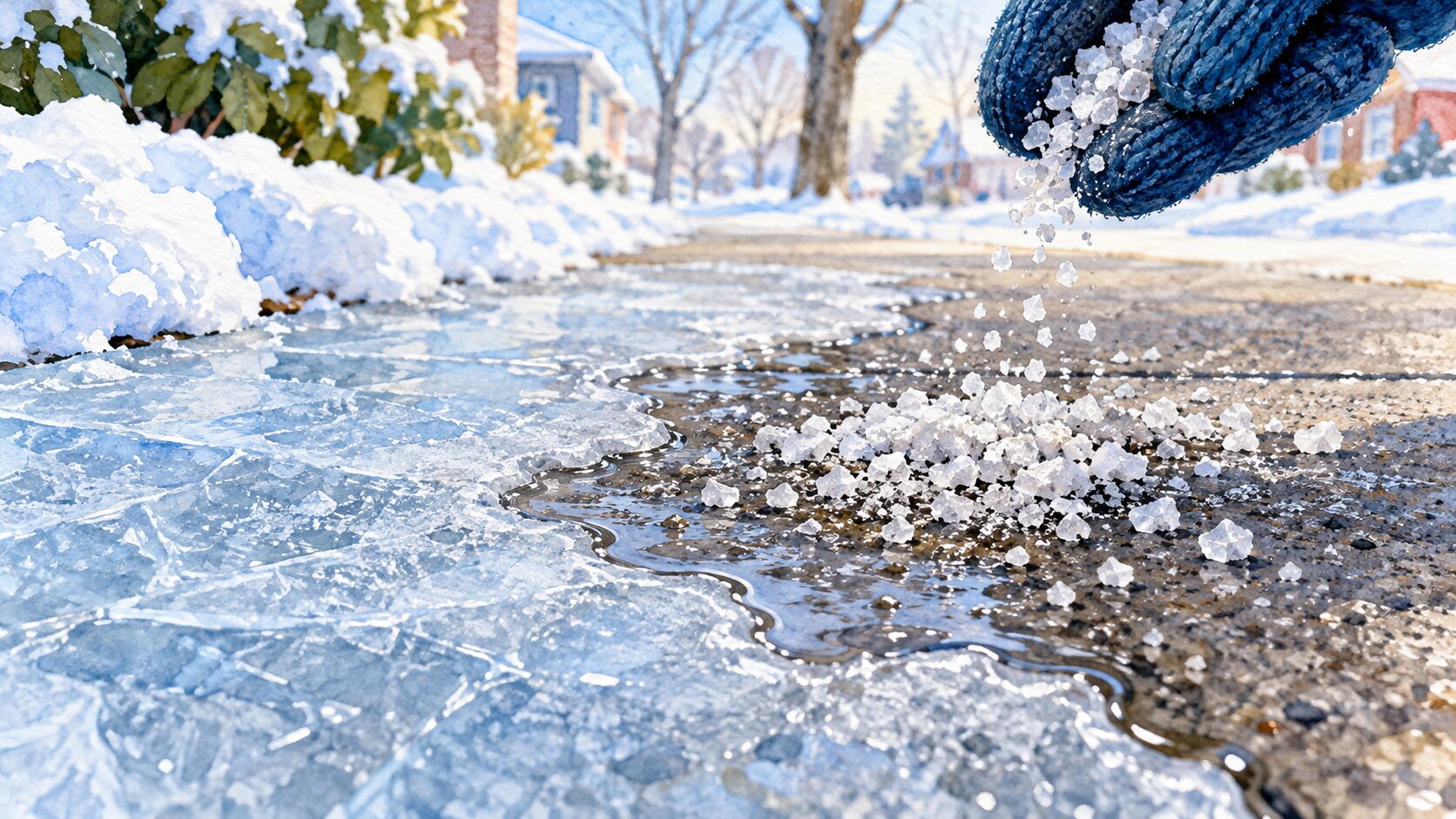
Look a little closer
Road salt helps melt ice mainly by lowering the freezing point of water, not by making the ice hot. When salt dissolves in water at the ice surface, it forms brine. That brine can remain liquid at a temperature where pure water would freeze, allowing more of the ice surface to melt and weakening the bond between the ice and the pavement. The effect depends on enough liquid water being available for the salt to dissolve, and on the actual temperature and concentration of the brine.
A dry grain of salt does not instantly liquefy a whole block of ice. It must first meet water at or near the surface. Even an apparently solid ice surface can have a very thin liquid layer under some conditions, and snow, meltwater, or damp pavement may supply more liquid. Dissolved salt separates into ions in that water. The resulting solution behaves differently from pure water when it cools or freezes. Highway agencies sometimes spread brine or pre-wetted salt so that the material can begin acting at the pavement surface without waiting as long for dry crystals to dissolve.
Pure water freezes at about 0°C under ordinary pressure. Dissolving salt moves the freezing temperature downward, with the result depending on how much salt is in the solution. At a pavement temperature slightly below zero, pure water would favor ice while a suitably concentrated brine may remain liquid. As the first bit of ice melts, it provides more water for salt to dissolve into, letting liquid reach more of the icy boundary. The U.S. Geological Survey explains the essential effect as deicer ions lowering water's freezing point. The ice is not responding to a special hot ingredient hidden in the salt.
Melting still requires energy. Turning ice into liquid water takes heat from somewhere in the surroundings, such as the pavement, air, or water already present. Lowering the freezing point changes which state is favored under the conditions; it does not remove the energy cost of melting. This distinction helps explain why the same quantity of salt can work at different rates on different days. A warmer pavement and available moisture may support faster change, while a very cold, dry surface may respond much more slowly. The amount of salt alone never tells the whole story.
For road crews, preventing a tough ice-to-pavement bond can matter as much as making every patch disappear. A thin brine layer at the boundary can make snow and ice easier to remove mechanically. Federal Highway Administration guidance treats deicing and anti-icing as related but different operations and emphasizes brine concentration, pavement temperature, and dilution during rain or snowfall. If new precipitation adds too much water, the brine becomes weaker and its freezing point rises. A surface that looked wet and clear can freeze again when the diluted solution no longer remains liquid at the pavement's temperature.
Salt also has practical limits at very low temperatures. A concentrated sodium-chloride solution can remain liquid far below zero in a controlled phase diagram, but that theoretical limit is not a promise of quick, economical melting on a road. The Federal Highway Administration notes that agencies often find ordinary salt too slow or impractical at much warmer temperatures than the lowest possible freezing point of concentrated brine. Conditions in the field include dilution, changing weather, traffic, and the time available to clear a route. A single claimed cutoff temperature cannot capture all of those factors.
More salt is not automatically the best answer. Dissolved chloride can move with runoff into soil, streams, and groundwater, a concern documented by the U.S. Geological Survey. Sensible winter maintenance uses a suitable amount for the conditions and removes snow and loosened ice where possible. On a household walkway, a thick scatter of crystals should likewise not be mistaken for instant protection on a deep, cold sheet of ice. The useful mental picture is a thin liquid interface: salt dissolves, the interface has a lower freezing point, and the ice becomes easier to melt or separate. When temperature, water, or concentration changes, so does the outcome.
EDITORIAL RESPONSIBILITY
FactosBrain Editorial Desk
The FactosBrain Editorial Desk researched and reviewed this article under our editorial policy. We assess error reports under our corrections policy.