Look a little closer
Diamond and graphite are both made of carbon, but their atoms connect in different patterns, producing very different materials. Graphite consists of strong atomic sheets held together much more weakly, while diamond has a network of strong bonds extending in three dimensions. That difference helps explain why graphite can leave a mark on paper while diamond resists scratching. Naming the element identifies the building material; it does not tell us how the building material has been assembled, or how the finished structure will respond to a force.
Different structural forms of the same element are called allotropes. Diamond is not graphite with a special extra element added, and the contrast cannot be explained simply by saying that its carbon has been packed more tightly. Which neighbors each atom connects to, and in which directions, matters. As a loose analogy, identical components could be assembled into a broad mesh or into a framework extending through space. Their behavior would depend on the connections as well as the components. In these two minerals, the relevant components are carbon atoms.
In diamond, each carbon atom forms strong covalent bonds with four neighboring carbon atoms. A covalent bond is a connection involving shared electrons. The four neighbors are arranged in a tetrahedral pattern, extending into three dimensions instead of sitting in one flat sheet. Repeating this arrangement produces a continuous crystal network. There is no equivalent of a loosely attached page that can simply slide away. Scratching the surface requires disturbing a strongly connected arrangement, which is why the bonding pattern is central to diamond's exceptional resistance to scratching.
Graphite gives each carbon atom three bonded neighbors within a plane, making sheets of linked hexagons. The bonds within a sheet are strong too. The crucial difference is that the attractions between sheets are much weaker than those connections inside them. Under suitable forces, layers can slide relative to one another or separate. Calling graphite soft should therefore not be taken to mean that all of its carbon bonds are weak. A single material can resist disturbance strongly in one direction while yielding much more readily along a different structural boundary.
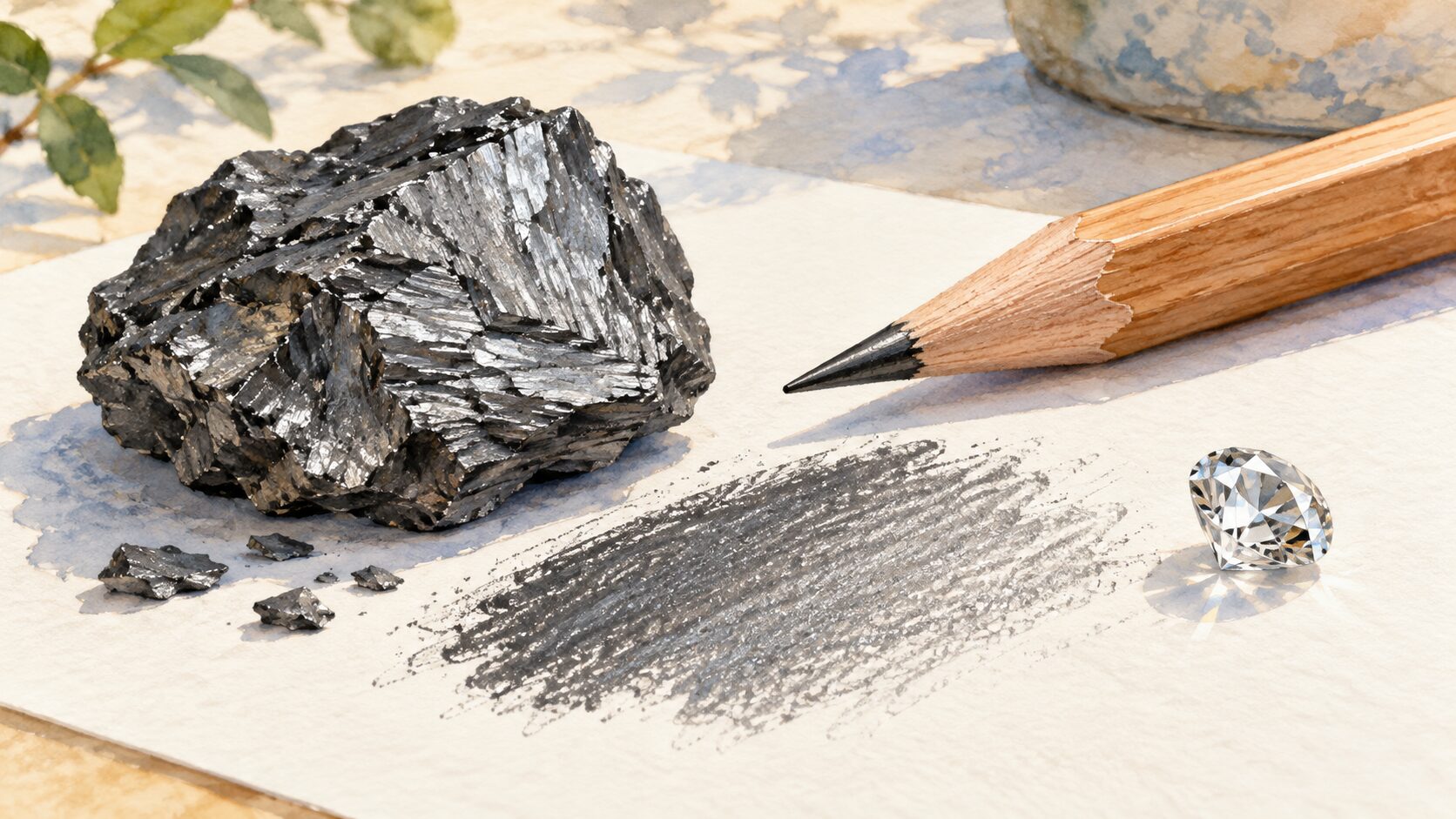
A pencil makes this arrangement tangible. As its point rubs across paper, small pieces of graphite transfer to the surface and produce a visible mark. The solid is not melting into a dark liquid, and the mark is not evidence that carbon atoms have changed into another substance. Material has moved from the pencil to the paper. Thinking about that transfer is more informative than simply associating graphite with stationery and diamond with jewelry: the useful everyday property follows from how easily portions of the layered solid can separate during rubbing.
The different structures also affect electrical behavior. In graphite, some electrons are not confined to a single connection between two atoms; they can extend through the sheets and carry charge. Graphite therefore conducts electricity despite being a nonmetal, with the behavior along its layers especially important. Electrons in ordinary pure diamond do not carry electrical current readily, so that material is treated as an electrical insulator. This is a comparison of typical forms under ordinary conditions. Deliberately introduced impurities or special conditions can change a diamond's behavior, so the useful contrast should not become an absolute rule about every possible specimen.
Diamond's hardness also needs a careful definition. Hardness concerns resistance to scratching or indentation; toughness concerns resistance to fracture. The Gemological Institute of America explains that diamond can chip and can split along particular crystal planes. An impact at a vulnerable edge or point can therefore damage a stone that is extremely difficult to scratch. A strong three-dimensional network does not make every location equally resistant to every possible load. Breaking a hard material is not a contradiction: scratching and fracture are different ways of disturbing a structure, and they test different aspects of its response.
The comparison becomes clearer when three questions are kept separate: what atoms are present, how they are connected, and what kind of disturbance is applied. Both minerals answer the first question with carbon, but their answers to the other two explain the pencil mark and the scratch-resistant gemstone. Simply piling graphite sheets together does not, by itself, describe the creation of diamond. The connections must be reorganized into a different network. The decisive change is in the relationships among the carbon atoms, rather than the addition of a mysterious ingredient that makes ordinary carbon precious or strong.
EDITORIAL RESPONSIBILITY
FactosBrain Editorial Desk
The FactosBrain Editorial Desk researched and reviewed this article under our editorial policy. We assess error reports under our corrections policy.