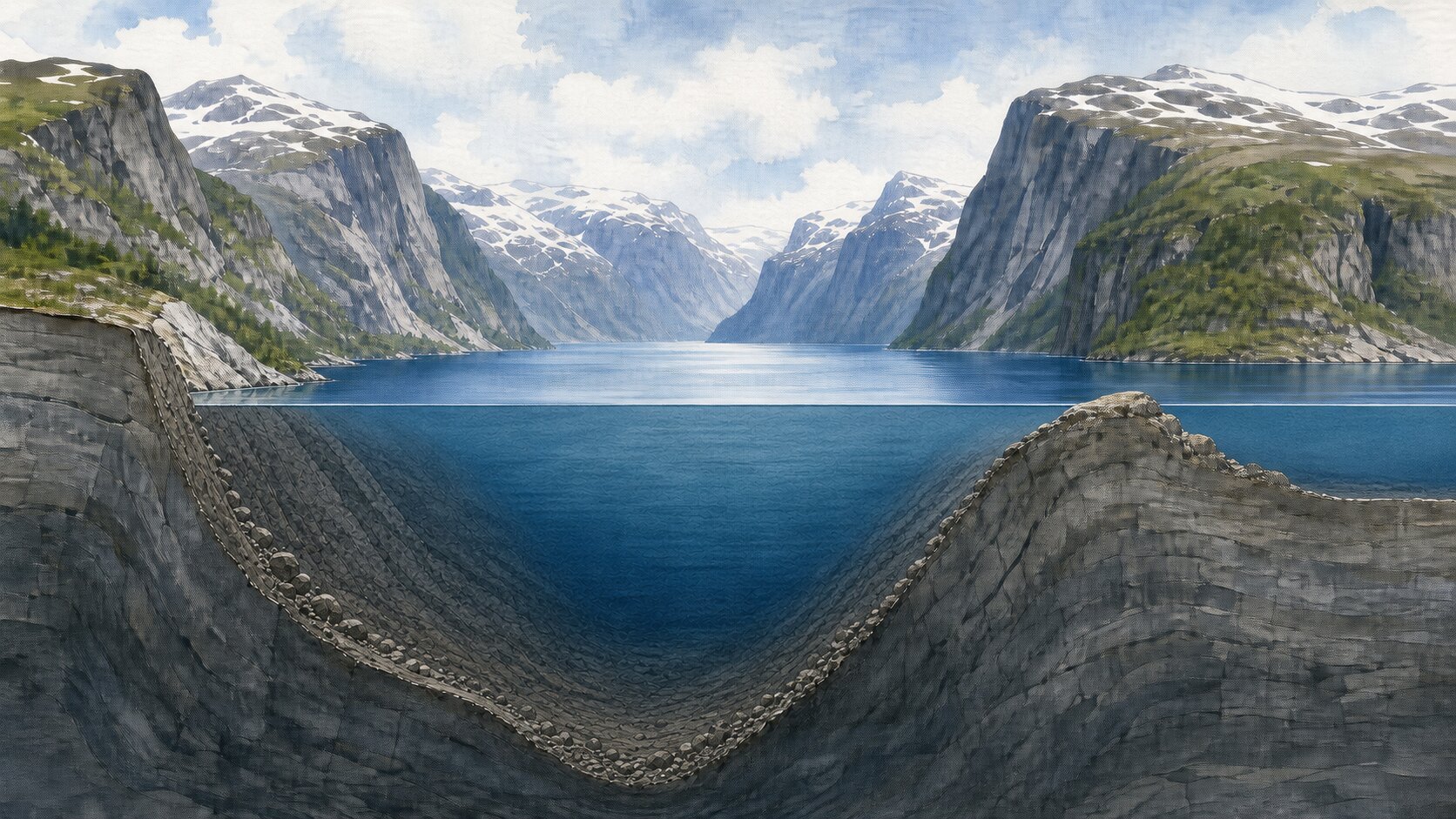
A fjord is narrow and deep because the sea did not excavate it. A large glacier first widened and deepened a mountain valley, and seawater later flooded the space left behind. The steep cliffs visible above the water can continue far below it, with some fjord floors lying lower than the continental shelf outside.
Before extensive glaciation, a river may cut a relatively narrow V-shaped valley. As climate cools, accumulated snow compacts into ice and a valley glacier begins to flow under gravity. Ice hundreds of meters thick fills the valley and presses against its floor and walls, applying force across a much broader area than a river confined to a channel.
Rock fragments and sand frozen into the glacier's base abrade bedrock like an enormous moving rasp. Water, freezing and pressure changes around fractures can also help loosen blocks for the ice to quarry away. Repeated episodes of glaciation turn the valley toward the broad floor and steep walls of a U-shaped cross-section.
Some reaches are cut below sea level and even below the fjord's entrance, a form known as overdeepening. Erosion may be stronger where ice is thick and fast or the bedrock is easier to remove. Where the channel widens toward the coast and ice spreads out, reduced erosion or deposited sediment can leave a relatively shallow sill. The exact interplay of ice flow, subglacial water and rock remains an active research problem rather than a single settled recipe for every fjord.
When the climate warms and the glacier retreats, seawater enters the excavated valley. A fjord is therefore a long inlet of the sea that retains the geometry of a glacial landscape. A shallow sill near its mouth can restrict exchange between deep fjord water and the open ocean, influencing temperature, salinity and oxygen within the basin.
This sequence also explains why fjords cluster along mountainous coasts at high latitudes, including Norway, Alaska and New Zealand's South Island. High relief, glaciers and access to the sea must coincide so ice can excavate a valley that seawater later occupies. Not every U-shaped glacial valley becomes a fjord; without a marine connection, it remains a land valley or fills as a lake.
A fjord's depth was not created at the moment the sea advanced between the mountains. Long before that, thick moving ice carried away rock and lowered parts of the valley beneath sea level. The ocean merely occupied the finished excavation. Beneath today's calm surface, the thickness and route of an ancient glacier remain recorded as a negative shape in stone.
EDITORIAL RESPONSIBILITY
FactosBrain Editorial Desk
The FactosBrain Editorial Desk researched and reviewed this article under our editorial policy. We assess error reports under our corrections policy.