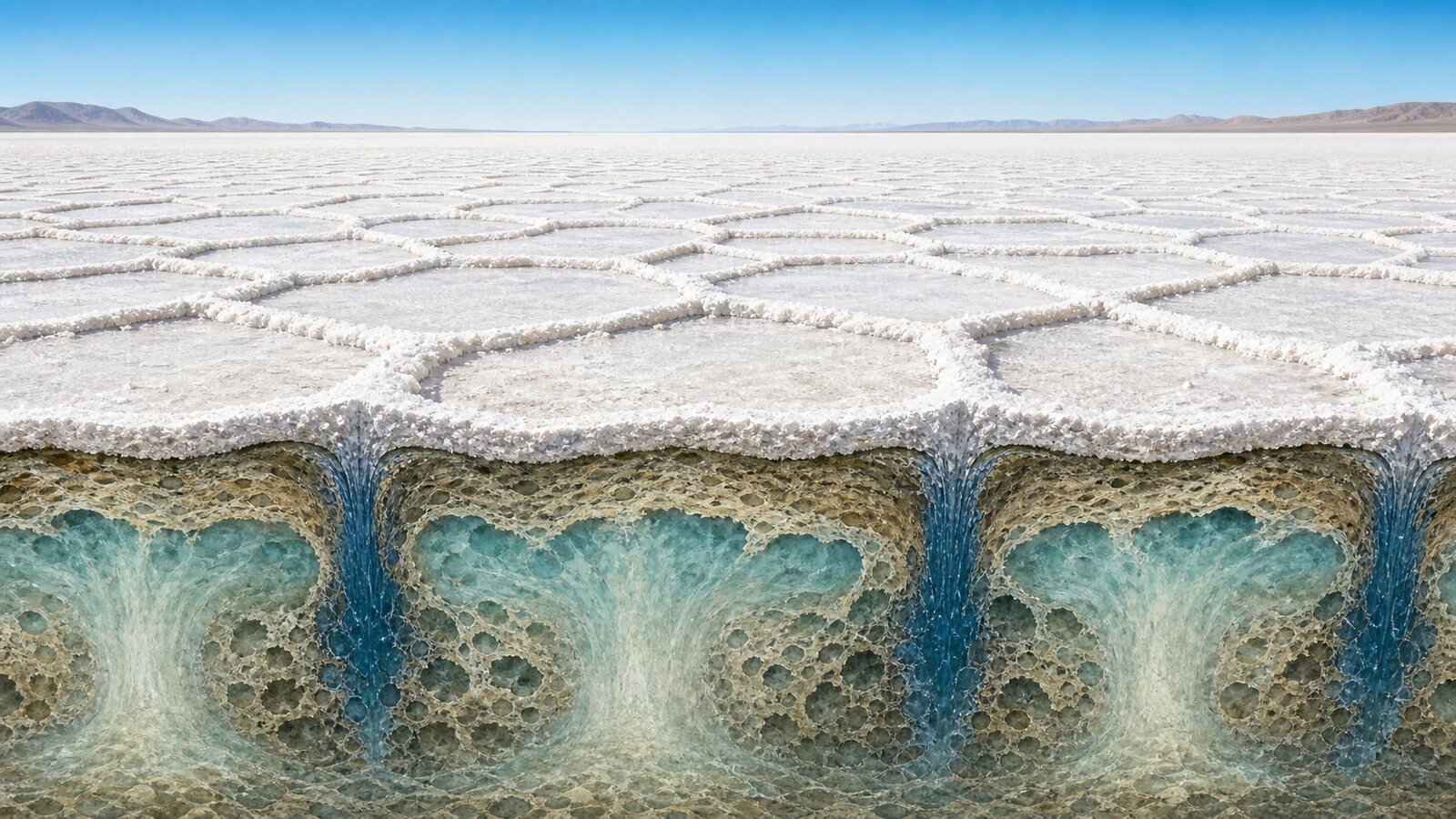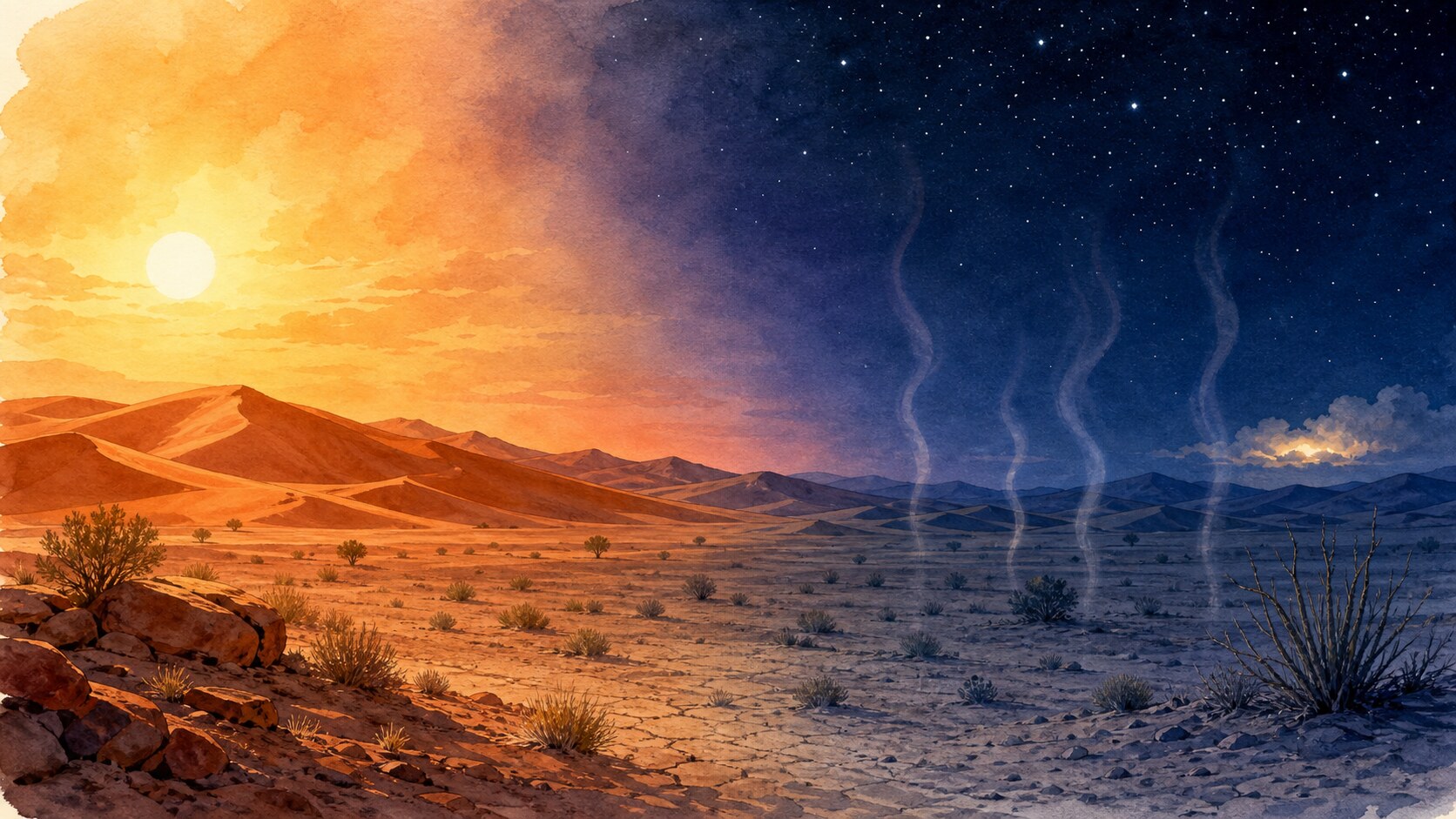
Many deserts have a large day-to-night temperature range because a dry surface gains solar energy quickly by day and loses energy as infrared radiation after sunset. Cooling is especially strong on clear, dry nights with light winds, when relatively little energy is returned to the ground and cold air can remain close to the surface.
During the day, sparse cloud allows intense sunlight to reach desert ground. With little moisture and vegetation, less incoming energy is spent evaporating water, and exposed sand or rock can heat rapidly. Surface temperature is not the same as the official shaded air temperature, however, and the air across an entire desert is not uniformly as hot as sunlit ground.
After sunset, the energy budget reverses. The ground continues to emit infrared radiation while incoming solar energy disappears. When the surface sends more radiation upward than it receives back from the atmosphere, it undergoes radiational cooling. The cooling ground then draws heat from the thin layer of air touching it, lowering temperature near the surface.
Water vapour and clouds strongly influence how far that cooling goes. Both absorb infrared radiation and emit some back toward the ground. On a humid or cloudy night, this downward radiation reduces the surface’s net energy loss. Clear desert air contains less water vapour and fewer clouds to participate in that exchange, so the ground can cool more efficiently.
Wind changes the result as well. With light winds, cold air stays near the ground and warmer air can remain above it, forming a nighttime temperature inversion. Stronger wind mixes the lower atmosphere and brings some of that warmer air downward, often limiting the drop at the surface. A wind that imports cold air from elsewhere can, of course, produce a different outcome.
“Deserts are cold at night” is still an overgeneralization. A desert is defined primarily by low precipitation, not by one temperature pattern. Elevation, latitude, season, cloud, wind, humidity and distance from the sea all matter. A low desert city can remain very hot through a summer night, while a high or winter desert may fall below freezing.
The large temperature swing is therefore not created by sand somehow manufacturing cold. It comes from the conditions controlling energy into and out of the surface. Clear skies admit strong sunlight by day, while dry air and sparse cloud provide less downward infrared radiation at night. The same environment can support rapid daytime heating and rapid nighttime cooling in succession.
EDITORIAL RESPONSIBILITY
FactosBrain Editorial Desk
The FactosBrain Editorial Desk researched and reviewed this article under our editorial policy. We assess error reports under our corrections policy.