Look a little closer
A waterfall retreats upstream not because water reverses direction, but because erosion and rock failure repeatedly relocate the brink. Falling water and its load of sand and gravel wear the base and cliff; when unsupported rock is removed, the next stable edge lies farther toward the source. The familiar sequence of undercutting a soft layer and collapsing a hard cap is real in some settings, but it is not the only way a bedrock waterfall migrates.
Geomorphologists call a sudden steep step in a river's longitudinal profile a knickpoint; a waterfall is a large one. Water continues downstream while the position of that step propagates upstream through erosion. As the brink shifts, it can leave a steep-sided gorge or a staircase of abandoned ledges between the old and new positions. The channel downstream is therefore capable of preserving a partial track of where the fall once stood.
At the drop, gravitational potential energy becomes a fast jet and turbulent impact. The plunging flow circulates through the pool below, while entrained sand, pebbles, and cobbles strike the bedrock repeatedly. This abrasion excavates a plunge pool. Pressure fluctuations and the opening of existing fractures can also loosen blocks, but in strong rock, moving sediment is often a crucial cutting agent. The water supplies motion and transport; the grains make concentrated impacts against the surface.
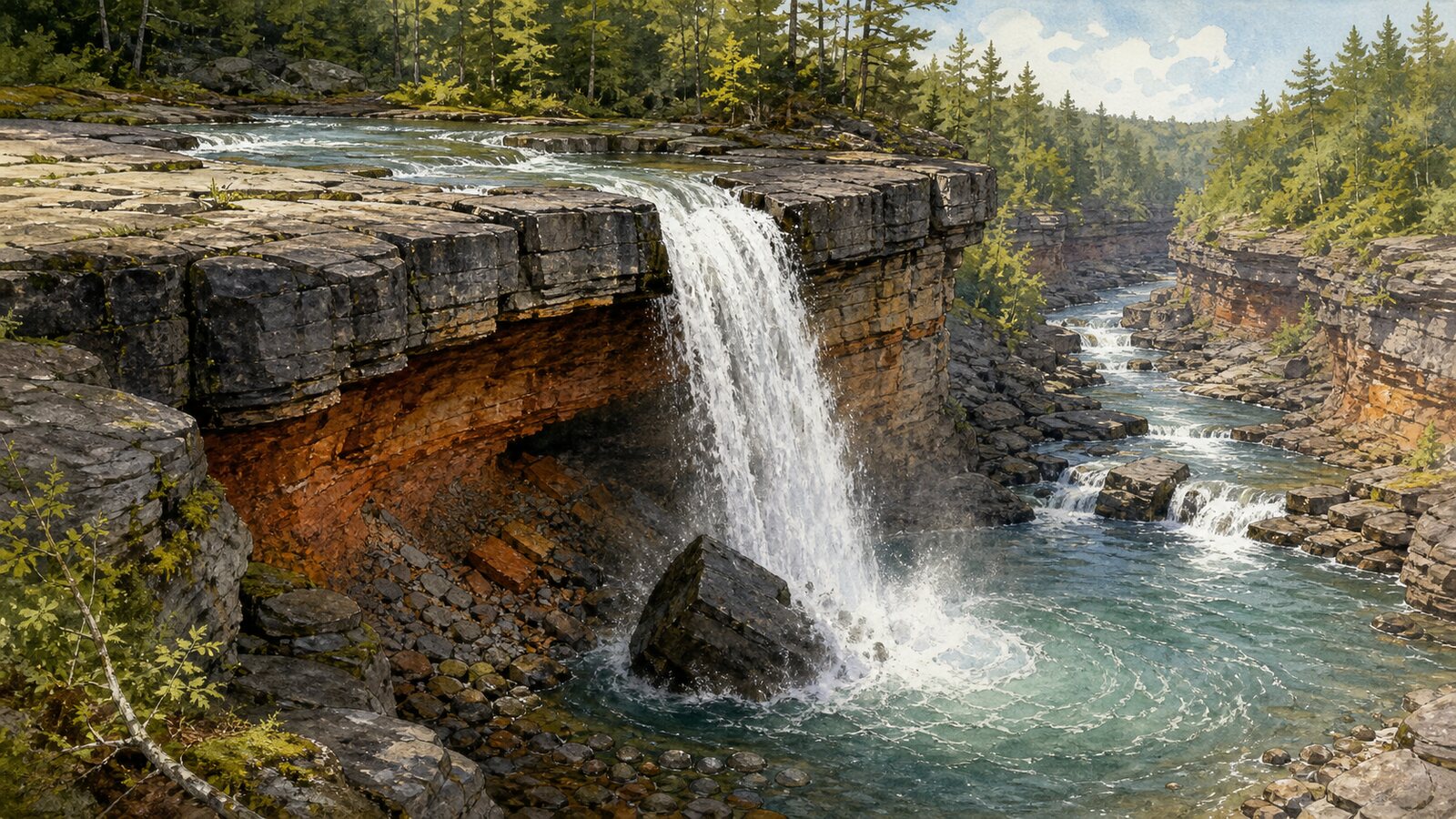
Horizontally layered rock can support the classic caprock mechanism. Suppose a resistant bed forms the lip above weaker shale or weathered material. Turbulence and sediment attack the lower layer faster, carving a recess beneath the stronger bed. The projecting cap becomes a cantilever with diminishing support. Once fractures and its own weight overcome its strength, a slab falls into the pool. After the debris is broken or carried away, a fresh face is exposed and the cycle can move the lip one increment upstream.
Repeated failures may leave an alcove behind the falling water and lengthen a narrow gorge downstream. The US National Park Service describes ancient lava dams in the Grand Canyon being dismantled by receding cataracts: water weakened the end of a basalt flow from below, the lip failed, and erosion attacked the next position. Niagara Falls is another well-known layered-rock example. Such visible collapses make an intuitive model, but their familiarity should not turn one geological arrangement into a universal rule.
In more homogeneous rock, erosion of the plunge-pool floor may matter more than lateral undercutting of the headwall. A 2017 laboratory study dropped sediment-laden water onto synthetic bedrock and allowed pools to develop without a pre-cut cliff. Before deposited grains armored the floor, vertical incision was about ten times faster than lateral erosion, and the upstream pool wall was not undercut. A related physical model showed how a sequence of vertically drilling pools and small steps can make the whole steep knickzone propagate upstream.
These are different styles of retreat: one cliff repeatedly loses an overhanging cap, whereas another reach develops successive downward-drilling pools whose collective position advances upstream. Jointed bedrock adds further possibilities because flowing water can exploit cracks and detach columns or plates without first removing a continuous weak layer. A natural fall can combine floor abrasion, sidewall widening, undercutting, and block toppling, with their relative importance changing through time. Surface appearance alone may not reveal the controlling structure inside the rock.
Retreat rate is not set by waterfall height alone. Greater discharge can deliver more energetic water and sediment, and an available supply of mobile grains can intensify impact wear. Too much sediment may instead fill a plunge pool and shield its floor like armor until floods export the cover. Rock strength, bedding and joint orientation, grain size, flood frequency, and downstream water level also alter the result. A waterfall can move abruptly when one large block fails after a flood, then appear fixed for a long interval.
Upstream retreat is part of a river adjusting its profile to a change in elevation, not merely a cliff becoming ragged. A migrating knickpoint can deepen the upstream channel, steepen adjacent hillslopes, and leave a gorge and old pool forms behind. There is no paradoxical uphill flow: the boundary called a waterfall moves toward rock that has not yet been removed. Distinguishing layered-rock collapse from sequential vertical drilling explains both why waterfalls commonly migrate in one direction and why their visible routes and rates differ so widely.
EDITORIAL RESPONSIBILITY
FactosBrain Editorial Desk
The FactosBrain Editorial Desk researched and reviewed this article under our editorial policy. We assess error reports under our corrections policy.