Look a little closer
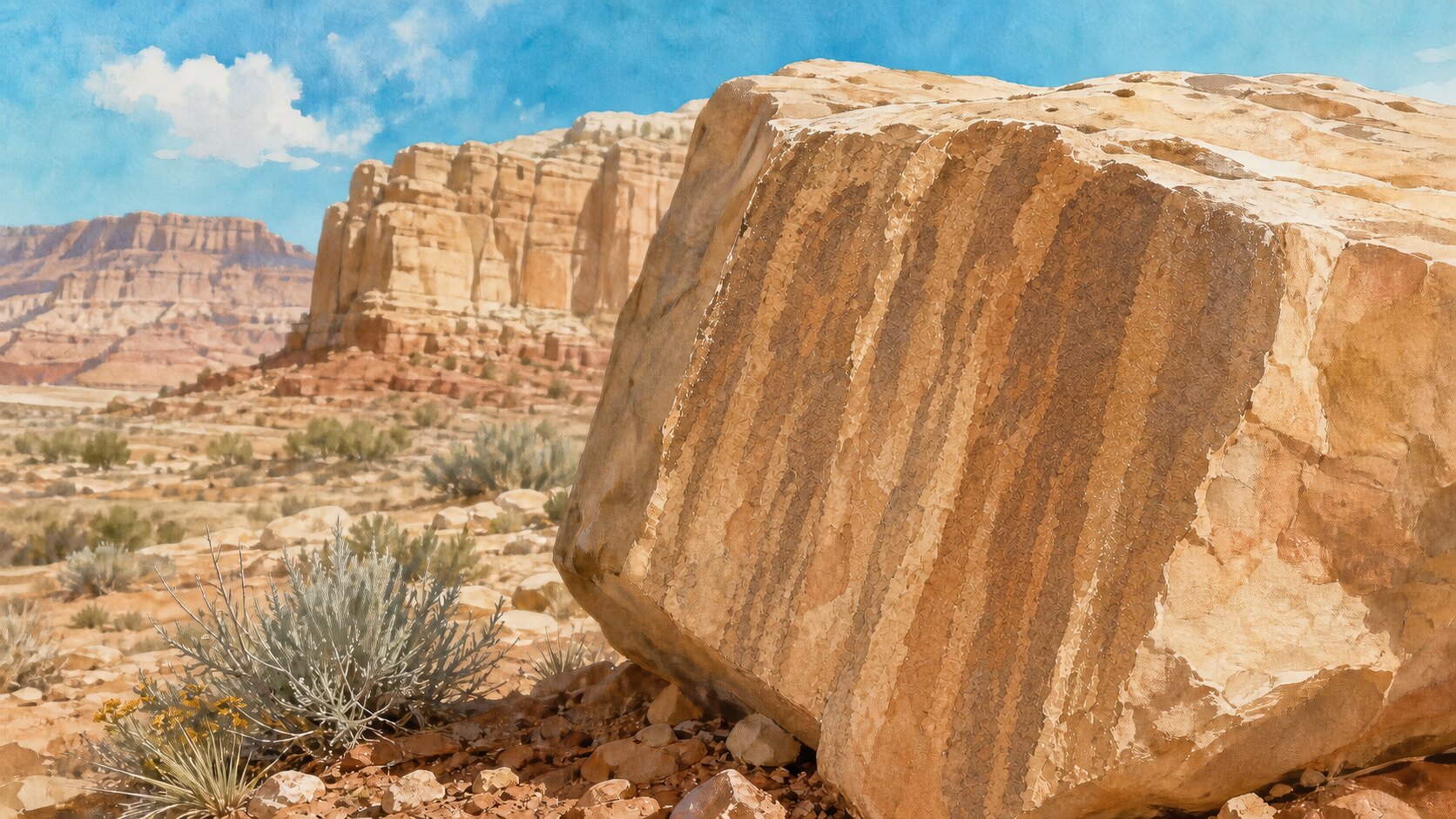
The dark or reddish sheen on many desert rocks is not a sunburned surface. It is desert varnish, a very thin coating built as clay particles and manganese and iron compounds accumulate over long periods. Windborne dust settles, occasional dew or rain wets the surface, and oxides bind the fine material through repeated cycles. The broad process is established, but exactly how manganese becomes so concentrated—and how much microorganisms contribute—remains dependent on site and unresolved in detail.
Despite its name, desert varnish is not a transparent glassy lacquer. Microscopic and chemical analyses show a matrix dominated by fine clay minerals, with oxides and hydroxides of iron and manganese supplying cement and color. A greater influence from manganese oxides tends to produce dark brown or black coatings, while iron compounds favor red and orange tones. The coloration is confined to the surface, so a fresh fracture or chip can expose much paler rock beneath.
Dust is an important source of the raw material. Desert winds deposit tiny clay particles carrying iron, manganese, and other elements, sometimes transported from far away. Even an arid surface is not perpetually dry: nighttime dew, fog, a short rain shower, or a thin runoff path can wet the deposit and permit chemical reactions. The water evaporates but leaves solids behind. As wetting, reaction, and drying recur, a film can develop incrementally rather than appearing in one coating event.
Iron and manganese can both react with oxygen, yet their behavior in varnish is not identical. Some coatings contain manganese at concentrations far above those in nearby dust or substrate, a feature that has driven much of the scientific debate. Oxides attach to clay surfaces and help cement the particles into a durable microlayer. Water chemistry, duration of moisture, dust composition, sunlight, and surface texture can all affect the reactions. Adjacent faces may therefore acquire a black streak, a rust-red patch, or little coating at all.
Microorganisms are plausible participants, but the explanation should not be reduced to 'bacteria paint the rock.' Certain bacteria and fungi can promote manganese or iron oxidation, and cell surfaces or organic residues may provide sites that trap minerals. Organisms and possible biological textures have been found in varnish, supporting a contribution in at least some settings. Yet mineral oxidation and direct dust deposition can also occur without life. Current evidence allows biological and abiotic processes to work together rather than requiring one universal recipe.
The coating survives best on stable exposed faces. Sand abrasion, flaking, floods, or repeated fracture can remove material faster than it accumulates. A sheltered face that has remained intact for a long time offers a better archive. Vertical streaks may reflect paths of intermittent water and dust capture, while a crack or newly exposed edge has less developed varnish. Darkness consequently records a surface's exposure and preservation history, not simply the age of the whole boulder.
Many petroglyphs in the American Southwest were made by Indigenous artists who pecked through dark varnish to reveal contrasting pale rock. That contrast can last for centuries, but the degree of later darkening is not a simple clock. Growth rates differ with climate, orientation, material supply, and erosion, and a new coating does not return uniformly. Touching, tracing, or adding marks to such a surface damages both cultural heritage and the environmental record scientists might otherwise study.
The word desert also needs qualification. Rock varnish can form outside deserts, but arid landscapes expose abundant bare stone and may preserve coatings where vegetation, soil development, intense chemical weathering, or frequent washing would obscure them elsewhere. Nor is every black desert stain varnish. Soot, runoff deposits, algae, lichens, iron stains, and other coatings can resemble it from a distance. Identifying true varnish may require composition and microstructure rather than color alone.
Desert varnish is thus a record assembled from innumerable brief encounters among dust, moisture, oxygen, minerals, and sometimes microbes. Manganese and iron compounds deepen the color and bind clay, while a quiet rock face preserves the slow construction. The resulting dark sheen says less about the color inside the rock than about how long its outermost skin has remained open to the atmosphere, weather, and life.
EDITORIAL RESPONSIBILITY
FactosBrain Editorial Desk
The FactosBrain Editorial Desk researched and reviewed this article under our editorial policy. We assess error reports under our corrections policy.