Look a little closer
A Moon near the horizon looks unusually large because the brain is interpreting size and distance within a scene, not because the Moon or atmosphere magnifies its image. Photographs made with the same focal length show nearly the same horizontal angular diameter at moonrise and later in the sky. From the observer's position, the horizon Moon can actually be slightly farther away, and therefore fractionally smaller, than the Moon overhead.
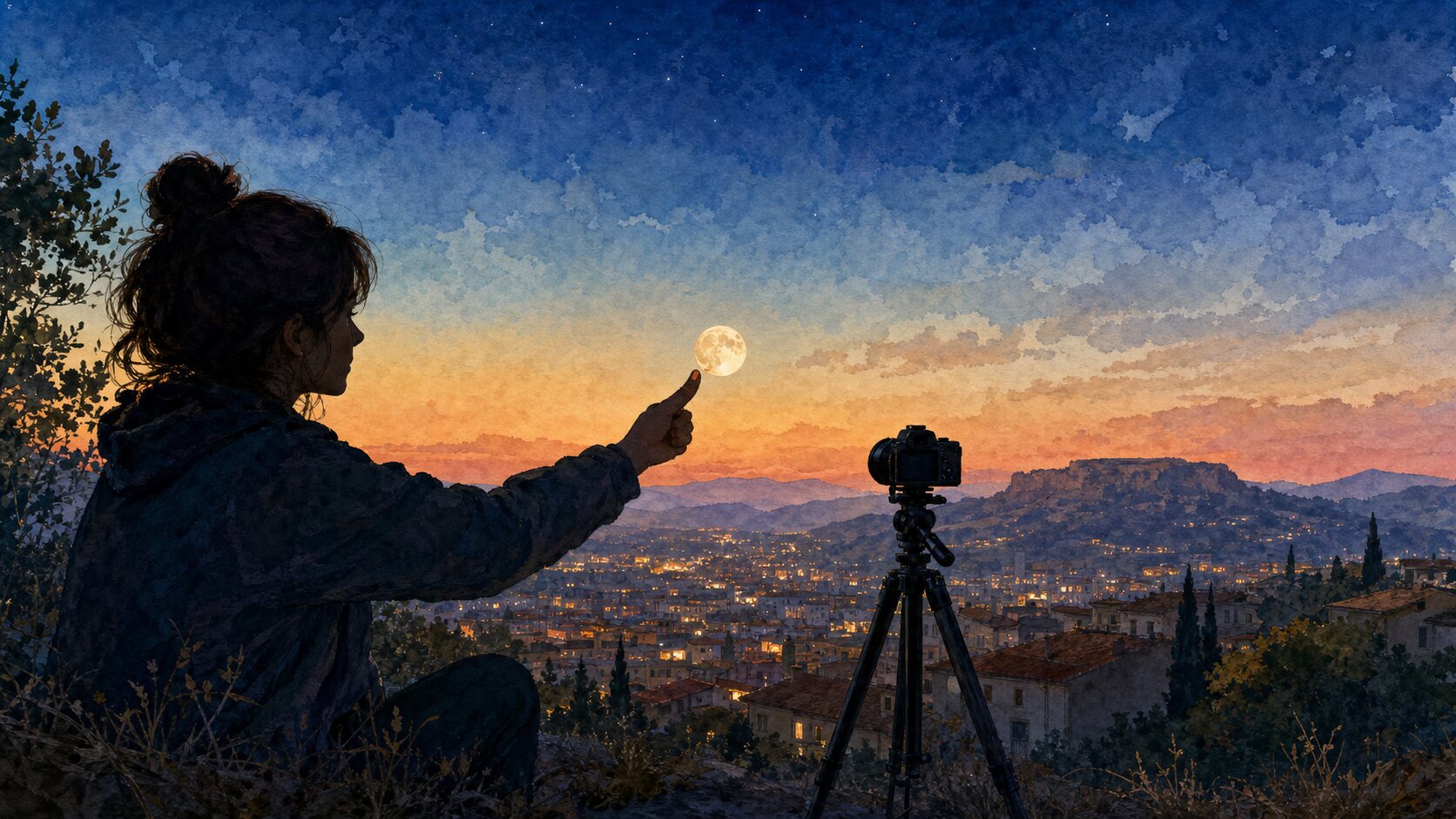
Angular diameter is the angle an object occupies in the field of view. The Moon is about 3,475 kilometers wide and typically spans roughly half a degree. Photograph it at a fixed zoom and crop, then count the pixels across its disk: the dramatic change reported by the eye is largely absent. An outstretched fingernail provides a rough comparison, while a paper tube that blocks the surrounding landscape often makes the low Moon seem less imposing.
The small physical distance difference arises from Earth's size. When the Moon is directly overhead, an observer on the surface is about one Earth radius closer than Earth's center is. Near the horizon, almost all of that advantage disappears. This same-night geometry must be separated from genuine changes caused by the Moon's elliptical orbit over many days. A so-called supermoon can have a measurably larger angular diameter, but orbital variation and the horizon illusion are independent effects that may occur together.
The atmosphere is not a giant magnifying glass. Low in the sky, moonlight travels through more air, so increased scattering removes more short blue wavelengths and can leave the disk yellow or orange. Refraction also bends light near the horizon, with rays from the lower edge bent more than those from the upper edge. That difference can slightly squash the disk vertically. Color and flattening are real optical effects; neither accounts for the much larger size people perceive.
A leading family of explanations involves size constancy and distance cues. Vision does not read retinal image size in isolation. The brain combines it with an estimate of distance to infer how large an object probably is. Trees, buildings, overlapping ridges, ground texture, and perspective supply a long chain of depth information toward the horizon. If a half-degree disk is interpreted as belonging at the far end of that scene, the visual system may scale its perceived size upward. The empty overhead sky offers far fewer distance markers.
Relative-size contrast can contribute as well. Distant houses and trees occupy tiny visual angles, making the Moon framed among them look large by comparison. This resembles the Ponzo illusion, in which equal lines placed at different positions among converging perspective cues appear unequal. In an fMRI experiment using a virtual three-dimensional scene, participants judged an identical Moon stimulus as larger when it was low within the landscape. The effect disappeared on a neutral background, and activity in visual pathways changed with perceived size and scene context.
No single account explains every observation. Some people experience the illusion over a sparse ocean horizon, and observers often report the low Moon as both larger and closer—the troublesome size-distance paradox. Eye elevation, convergence and accommodation, the apparent shape of the sky, brightness, learned expectations, and individual experience have all been proposed as contributing factors. Researchers agree that perception is central, but there is still no universally accepted mechanism that predicts every setting and observer.
Enormous Moon photographs add a separate source of confusion. A photographer using a long lens can enlarge both a distant skyline and the Moon within a narrow frame. The compressed perspective makes them appear close together, producing a spectacular composition without the atmosphere enlarging the lunar disk. A phone's wide lens includes much more sky, so the same Moon that felt immense to the observer may look disappointingly small in the image. Perceptual context and photographic field of view are different effects.
At the next moonrise, enjoy the first impression, then compare it with a restricted view. Cover the landscape with your hands or a tube, check the disk against your fingernail, and repeat the observation when the Moon is higher. The physical disk and the experienced size will behave differently. The horizon Moon is not a failure of sight; it exposes the normally useful calculations that let the brain recover stable object sizes from distance and context when those cues are applied to a celestial object with no familiar scale.
EDITORIAL RESPONSIBILITY
FactosBrain Editorial Desk
The FactosBrain Editorial Desk researched and reviewed this article under our editorial policy. We assess error reports under our corrections policy.